




FORTNIGHT ISA MULTIMEDIA DOCUMENTARY PROJECT ON THE MILLENNIAL GENERATION: THE LAST GENERATION TO REMEMBER A TIME WITHOUT THE INTERNET. |

contributorsprofile
the details

the details
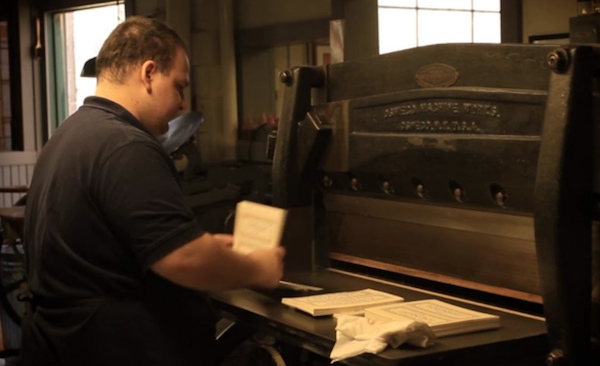
LETTERPRESS ARTIST ROB SHOWS US THE PRINTING PROCESS HAS AN ECOSYSTEM AS BEAUTIFUL AS THE PRODUCT IT PRODUCES.
watch the video now>>
LETTERPRESS ARTIST ROB SHOWS US THE PRINTING PROCESS HAS AN ECOSYSTEM AS BEAUTIFUL AS THE PRODUCT IT PRODUCES.
watch the video now>>


A Brief History of 557 Years of Letterpress and Typography
An Essay in Six Parts
Part 4
With the start of the 19th century, the technology of printing began to evolve at an increasing rate. Although the design of the press had not changed much since the time of Gutenberg, simple improvements continued to result in greater efficiency.
Essay continued on the next pag...
1/3
|
It was at about this time that Lord Stanhope was the first to have an all iron press made which dramatically improved the durability of the press and allowed larger pages to be printed. Before, the amount of pressure needed to print a large page was beyond the limits of even the best wooden presses. This would necessitate that some pages be printed in sections or with multiple pulls of the press, slowing production. Most presses were run by Even with this advance to iron, printing on a hand press was a relatively slow process. The type was placed on the bed of the press and inked by hand. A single sheet of paper was attached to a frisket which was then folded down onto the type. Next the bed and frisket were pushed or cranked under the platen. The platen is a flat plate that is forced down by a screw or similar device into the paper and type by use of a hand lever. The printer would give the lever a hard backbreaking pull, and then the bed could be rolled out and the entire process repeated. Most presses were run by a team of strong men where each man completed one of the steps being careful to make sure that the man who handled the ink did not also handle the clean paper. By 1802 an even better technology for printing large forms was in the early stages of development.a team of strong men. |
Although probably not the first to come up with the idea, Friedrich Koenig, a German printer, was the first to successfully work to develop a steam powered cylinder press. In a cylinder press, rather than the entire page of type being printed at once, a cylinder carrying a sheet of paper rolls over the type. As the cylinder rolls, only a small section is in contact with the type at any one time. This allows the press to apply greater and more even pressure across the page. Cylinder presses are also much faster as one sheet after another can be run through with less fuss. Previously, the technology simply did not exist to manufacture a perfect enough cylinder for printing. Variations of just a few hundredths of an inch are the difference between some letters printing, and some not. Koenig sold his first working presses to the London Times in 1814. Certainly much of the success of the newspaper is probably linked to its ability to print quickly and cheaply. The cylinder press, as well as the beginning use of paper making machines, is what really began to make mass-distribution as we know it possible. You might think that everyone would have been pleased by the improvements in technology, but it was not so. In 1896 William Morris, proprietor of the Kelmscott Press and influential member of the Arts and Crafts Movement, printed The Works of Geoffrey Chaucer. This volume would prove to be |
2/3
|
one of the most influential books ever printed, and was a direct reaction to changes of the time. The Arts and Crafts Movement was basically an aesthetic movement that looked back to historic designs, but it also emphasized the importance of the craftsperson over what had become the somewhat dull monotony of machine made goods. Morris printed his books on an old fashioned hand press and designed his own type based on the type of Jenson. Morris would become the inspiration for the small press movement, and indirectly, the contemporary field of book arts. *** Rob LoMascolo began studying letterpress and book arts at Wells College, in Aurora, NY. There he studied with Terry Chouinard, Herbert Johnson, Mark Argetsinger, and Michael Bixler. He received an MFA from the University of Alabama. He is currently a freelance letterpress and book arts artist in Union Springs, NY. Some of his clients included The Frick Collection, members of the Grolier Club, Wells College, private book collectors, and conservators. |
3/3




