



FORTNIGHT ISA MULTIMEDIA DOCUMENTARY PROJECT ON THE MILLENNIAL GENERATION: THE LAST GENERATION TO REMEMBER A TIME WITHOUT THE INTERNET. |

contributorsprofile
POP


|
I plodded on down to the Trident on west Pearl, where I drank a cup of coffee while half-heartedly poking around at a fifteen-line poem I’d been writing for three months (slow and steady goes the bullshit). When I gave it up, I wandered around Pearl for a bit, making my usual circuit of the used book stores. On my way home, I ducked into the Beat Book Shop (which was, uncharacteristically, open) and said hello to Tom. Tom Peters owns the Beat Book Shop, which has valiantly, bizarrely somehow held on in the face of skyrocketing Boulder rents. I don’t know how he does it, because I can’t imagine he turns much of a profit. The Beat Book Shop is a used bookstore that looks like an eccentric aging hippie’s garage sale. Here’s Tom: a tall, beefy guy with long, glossy, almost pretty hair, and a tuft of beard in the crease between his chin and lower lip (which I’ve heard called a “soul patch”). He’s the equivalent of an obsessive record store geek, except for avant-garde literature. Tom sells not just books and records, but whatever curious bric-a-brac happens to get sucked into his vortex. The store’s roughly the size of a large walk-in closet, and is crammed to bursting with musty old books, used vinyl and Beat Generation memorabilia—framed letters from Jack Keroac and that sort of thing. He’s got a typewriter in there that he claims used to belong to Gregory Corso. |
On that day, I saw a classic tin jack-in-the-box on a shelf behind the counter. It was sitting underneath a garish painting of Jack Kerouac. I looked at Tom, a warm guy who also MCs the poetry readings at Penny Lane, the coffee shop down the street from his store. I would go to a reading if a student of mine I liked was reading—which was rare—or, if I was bored and lonely—which was often. “Greetings,” Tom said in his sensei-serene voice when I walked in. “Howdy,” I said. There was a kid in there, a teenager. He looked like he was in high school. He was maybe about Julian’s age, maybe a bit younger. He had a phantom of a mustache that he wasn’t yet comfortable enough with a razor to shave, a little acne, glasses, a newsie cap and an R. Crumb T-shirt. He wore a backpack that sagged heavy at his shoulders. Not a big hit with the girls, this one, I presumed. He was paging through a copy of Narcissus and Goldmund. That’s right, I thought, keep the flame, kid. “Hey, Vincent,” said Tom to the kid. “Meet my friend Gary.” |
1/6
|
Vincent shook my hand a bit over-eagerly. “Hi,” he said. “Gary’s a poet,” Tom said. “Vincent read some of his poems at Penny Lane last week. They were really good.” “Thanks,” said Vincent, and I was almost afraid he would blush. “I want to be a poet.” “You are a poet,” I said. “You write poems, you’re a poet.” If I assemble a bookcase from Pottery Barn, that doesn't make me a carpenter. Did I mean that? I searched myself. No. It was a nice thing to say, but if I assemble a bookcase from Pottery Barn, that doesn’t make me a carpenter.“So who are you into?” “What?” “I mean, what poets do you like to read?” “Allen Ginsberg…” he said, searchingly. I was about to roll my eyes—of fucking course you’re into Ginsberg, squirt—when he added: “…Robert Creeley…” “Oh?” I said. “Now you’re talkin’.” |
“John Ashbery…” “Wow!” (I was genuinely impressed.) “You read living poets. Have you read Hart Crane?” Blank stare. “Do you have The Bridge around here, Tom?” Tom rooted around amid the chaos and procured a rough, coffee-stained paperback of The Bridge. I bought it from Tom, handed it to Vincent and said, “I’m giving you this under the condition that you won’t write any poetry until after you’ve read every fucking word in this book.” “Okay,” he said noncommittally, and took the book. He seemed nervous. His shoulders were drawn up. “Are there any of your books in here?” he asked. “I dunno, Tom, do I?” “There are a few over here, I think. Yeah, here they are.” The K section, if that’s what it was, happened to land me on the bottom shelf, right by the floor, right where browsers were sure to see them. There were three copies of What the Flesh Rebels Against |
2/6
|
there (Graywolf Press, 1992). It does not, I tell you, inflate a writer’s heart with joy to see three copies of his best book in a used bookshop. Vincent slid one of the copies of the skinny little book off the shelf. He flipped it over: there was a younger, thinner, hairier me, under which it read: Gary Kelly is the author of The Ghost of the Buick (1981), Joyous Gard (1986), and Omnicoron (1989). He is also a distinguished wine critic and founder of the wine magazine Vino Veritas. He is the recipient of a National Poetry Series award and a Howard Foundation Fellowship. He teaches at the Naropa Institute’s Jack Kerouac School of Disembodied Poetics and lives in Boulder, Colorado, with his wife, poet Madelyn Houghton-Kelly. “Can I read your poems?” said Vincent, as if he needed my permission. “No, you can’t read my poems,” I said, producing a hurt and confused look on his face. “Why not?” “Because reading my poetry is like seeing me naked. Why would anyone want to do that?” Now he was just confused. |
“I kid,” I said. “You can read my book if you want. But you’ll have to buy it yourself.” He flipped open the front cover to look at the price Tom had penciled into the corner. “How much is it, seven-fifty?” said Tom from behind the counter. “Yeah.” Vincent pulled out his wallet. “I only have a five.” “I’ll give it to you for five.” Vincent handed Tom a battered bill and Tom punched his old-fashioned cash register; it dinged and scrolled open. He flipped a clasp, dropped the five in its compartment and slammed the drawer shut with his hip. “My second sale of the day,” said Tom. Vincent thanked us, shook our hands and left. “Read Hart Crane first!” I told him as he was leaving. The door slammed shut and the string of bells tied to the knob tinkled against the glass. |
3/6
|
“That kid’s poems are actually pretty good,” said Tom. “Seriously.” “Eh. He’d do well to go into marketing.” I pointed at the jack-in-the-box on a shelf behind the counter. “Lemme see that,” I said. “Are you selling that?” “The jack-in-the-box?” Tom set it on the counter. “I found this in my basement a couple weeks ago. I brought it into the store and put it on the shelf. The end.” “That’s the best story I ever heard.” I picked up the jack-in-the-box. “I used to have one exactly like this when I was a kid. Same make and model or whatever, exactly like this.” Which was true. The object was a Proustian madeleine to me. Of course, that’s a weird-ass metaphor in my case because that word, as you know—though Madelyn spells it differently—has its own obvious significance to me. Me and Proust, man: that name is a serious memory-opener for both of us. But come on, Marcel—that was the name of my wife, whereas to you, even after |
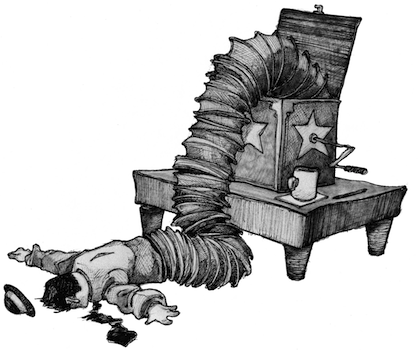
four-thousand pages of prose, it’s still just a fucking cookie. But the jack-in-the-box. Such a quaintly old-fashioned toy. I put the thing in the same mnemonic category as my slinky and my hobby horse. These were concrete, physical toys, designed to be touched, to have the paint rubbed off of them and get all gloopy-edged, worn smooth and shiny with use, with love. I doubt those things would get much of a rise out of a contemporary kid, accustomed to locking gaze into the palliative glow of an electronic screen all day, munching on Cheetos while committing murders and rapes with button-jiggering thumbs. The jack-in-the-box. The box itself is made of tin. This one was good and rusty, its edges jagged with wear, having gotten nice and sharp for baby to cut his grubby little fingers on. The sides of the box are splashed with garish color—red, yellow, blue. Clown colors. The front of the box features a picture of the clown puppet who lies sleeping lightly in a mischievous coil of potential energy under the lid of the box. You turn the crank on the side of the box, and with every click of the sprocket you feel you hear a note of the plinking, stupid song, “Pop! Goes the Weasel.” That’s the tune—but the tempo is up to you. You can turn the crank at a slow, barely rhythmic creep: dink … da—dink … da-diddly … donk …… If you turn it slowly you can feel the distinct plink of every vibration in your fingers, the |
4/6
|
tiny buildup-and-release of pressure that happens with every dink and donk. But in my opinion, “Pop! Goes the Weasel” sounds best when played allegro, that raucous, obnoxious jumping-bean of silly music—dink-da-dink-da-diddly-donk, da-dink-da-dink-da-da-donk, dink-da-dink-da-diddly-donk—climaxing there, right there, in the erratic high note that—sprong!—releases the puppet: a polka-dotted felt bag with flapping plastic hands and a grotesque pink-cheeked head with a cherry nose, wearing a bowler hat with a flower in the hatband. Now, if you want, turn the crank just a little more to hear the four-note dénouement: goes-the-wea-sel. In my opinion, “Pop! Goes the Weasel” I touched the crank and the lid sprang open and spat the puppet in my face.sounds best when played allegro... “Fuck!” I yelped, and dropped it. The jack-in-the-box clattered and banged across the bookshop floor. Tom had cautiously wound through the song, and left the crank of the jack-in-the-box precariously poised right before the “Pop!” in “Pop! Goes the Weasel,” so that the first person to turn the crank would immediately get blasted with a faceful of popping puppet. |
“Fuck you,” I said. “Jesus. Just about gayme a heart attack.” “Gotcha.” I stooped to pick up the jack-in-the-box. The clown lay forlornly on his side, one rosy cheek scraping the floor. “Shit,” I said, inspecting the damage. “I’m sorry.” One bottom corner of the pliable tin box was bashed in where I had dropped it. I set it back on the counter. It wouldn’t lie flat anymore—it was slightly cocked at an angle. “Well, now you have to buy it,” said Tom. “You broke it, you bought it.” “It’s not broken,” I said. “And it’s not my fault. But I’ll buy it anyway ’cause that’s just the kinda guy I am. What’s the damage, asshole?” “Five bucks.” I slipped a ten out of my wallet, which Tom took and gave me back the exact bill that kid had used to buy my book. Tom snapped open a brown paper bag. “I don’t need a bag,” I said. “I want to carry it.” |
5/6
|
I walked out of the bookshop carrying the rusty, dented jack-in-the-box. I deliberately didn’t stuff the puppet back in its hole because I liked getting weird looks from the passers-by. I was vaguely hoping maybe some good-looking single woman would remark on it, and we’d strike up a conversation, which would turn into, hey, why don’t we get lunch?—which would go so well I’d say, why don’t we get a drink?—which would go so well we would go to bed together—which would go so well we would fall in love, which would go so well we would get married, which would go so well I would be absolutely faithful to her and never, ever, ever take her for granted, which would go so well that decades later she would hold my hand as I die. Nobody said anything about it. I took the jack-in-the-box home and put it on my coffee table.  |
6/6




