



FORTNIGHT ISA MULTIMEDIA DOCUMENTARY PROJECT ON THE MILLENNIAL GENERATION: THE LAST GENERATION TO REMEMBER A TIME WITHOUT THE INTERNET. |

contributorsprofile
LEGGO MY EGO

LEGGO MY EGO
TRICKSTER THIEVES ARE FOR KIDS:
BENJAMIN SEEKS EROS
IN ANCIENT GREEK AND EIGHTIES ADVERTS.
read the essay now >>
TRICKSTER THIEVES ARE FOR KIDS:
BENJAMIN SEEKS EROS
IN ANCIENT GREEK AND EIGHTIES ADVERTS.
read the essay now >>

|
I signed up for my first class in Ancient Greek mostly because I wanted to get to know the legendarily eccentric professor, Sam Seigle, who taught Classics at Sarah Lawrence College. I still consider Sam a great friend, and from time to time I take the train up from New York City to visit him. He's 78 now, and still teaching full-time. The harmonious and liquidly transformative geometry of its grammar can be dazzling. But this amazing man is not the subject of this essay. I bring him up because, while studying Ancient Greek with Sam, I read a lot of Plato. Plato's prose, even for Greek, is particularly mazy, with double entendres and circuitous grammatical magic tricks that are very specific to the Greek language. It's hard to describe to someone who hasn't studied it, but Ancient Greek is a language built for labyrinthine wordplay. Reading a really interesting sentence of Plato in Greek is the linguistic equivalent of peering into a kaleidoscope—the harmonious and liquidly transformative geometry of its grammar can be dazzling.When I was first starting to struggle my way through Plato as a sophomore in college, I had a very interesting dream. |
My dream was basically an Eggo Waffles commercial. Any American child born between say, 1970 and 1995 probably has the tagline from those commercials burned irreversibly into their brain. Maybe they're still on TV, I don't know; I haven't watched Saturday morning cartoons since I became interested in Saturday nights. The commercial would usually go something like this (though YouTube has recently jogged my memory that there were many variants): Big Brother hovers expectantly over the toaster, waiting for his Eggo Waffle to pop out in a state of crisp, golden perfection. The instant the waffle leaps out of its slot in the toaster, Little Brother swoops in from out of nowhere. Swiping the waffle before his lumbering, dimwitted Big Brother knows what's happening, Little Brother is already halfway out the door and on his way to school, backpack slung rakishly over one shoulder, triumphantly waving the snatched waffle. And Big Brother, his sense of elder-born entitlement ripped out from under him, looks at Little Brother in hurt, baffled dismay, and says: "Hey! It was always some variation of that scenario: A younger brother stealing the Eggo Waffle from an older brother, or a son from a father. Or, an attempted theft was thwarted. But whatever happened, the underdog figure always got the |

1/5
|
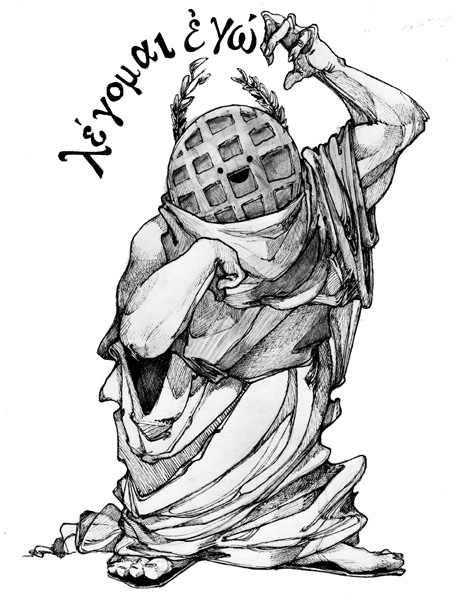
Eggo, and the last line was always, "Leggo my Eggo!" At the end of the vignette we cut to a plate of Eggo Waffles, sopping in syrup and a melting pat of butter, this delicious goo brimming over the edges of one waffle-cell to the next, cascading down the waffle-pile. The waffles were accompanied by some classic synecdoche for the concept of breakfast: coffee, juice, etcetera. Behind this still life was the Eggo Waffles box‚ the product, showing you the thing you were supposed to pester your mom to buy you in the grocery store. On the box was a magnified picture of the Eggo Waffles, enlarged to show texture. Above the waffles, written in a bubbly red cursive script, read the name of the product. But in my dream, the object looked like this:  |
I created this illustration by carefully doctoring a picture of a box of Eggo Waffles in Photoshop, and I confess I'm a little proud of it. Instead of "Eggo Waffles," the box reads, in Ancient Greek, “λέγομαι ἐγώ”— the first word being the first-person singular indicative middle passive form of the common Greek verb λέγω, meaning "to speak," and the second word being ἐγώ, which is essentially the Greek word for "I." But it's more than just "I": it means one's self, one's being, and it's the word from which we derive "ego." The phrase in Greek is an almost exact, syllable-for-syllable homonym for the phrase "Leggo my Eggo!" But in Ancient Greek, the multifocal language of Plato, Homer and Heraclitus, the phrase can be interpreted in multiple ways. It could mean something as mundane as "I say to myself," but grammatically, it basically means "I get myself spoken," which I think could be interpreted to mean, "I speak myself into existence." This connection led me to the thought that the theme of the fight between brothers over the Eggo Waffle is a contemporary reinterpretation of a very old story. The mythopoetic archetypes are there. It's Jacob stealing the birth rite from Esau. |
2/5
|
This, in turn, led me to thinking about other commercials for food aimed at children. I identified several common strategies. The mythopoetic archetypes are there. It's Jacob stealing the birth rite from Esau. One is to instigate generational warfare: the Orwellian tactic of turning children against their parents. The 1980s-1990s Apple Jacks campaign is a good example of this. An Apple Jacks commercial from this period would typically feature a group of "cool kid" older preteens, sloppily dressed, confidant, laid-back and laconic, sitting around in a tree house or similar hangout spot (suggestive of the interstitial time between "pure" childhood and early adolescence), passing around a box of Apple Jacks, from which the kids are eating handfuls of the cereal—dry, raw, loose. (The communal passing-around of a key socio-centric object is obviously a stand-in for teenage vices soon to come: a bottle of booze, a joint.) At some point, an uncool adult—say, a well-intentioned but helplessly clueless dad—intrudes on the situation to sample the Apple Jacks, and says, "They don't even taste like Apples."The kids shrug. They don't care if it tastes like apples or not. They just like them, so, like, fuck it. Why not? One of the kids says: "It's a kid thing." |
Then the dad shakes his head and walks away in bafflement, probably wondering how such a generation will one day fill the labor force, and what will become of the civilization of his fathers when these incomprehensible brats inherit the earth. The Apple Jacks commercial says to kids: We are on your side. You and we are united in opposition against the adult world. Of course, this strategy may backfire, as parents will at some point become necessary to actually buy the product. I'm sure this was the idea behind the much softer, kinder slogan for Kix cereal: "Kid Tested. Mother Approved." I'm hard-pressed to think of any other breakfast cereal that was openly marketed to both children and their parents simultaneously. I don't have the data on exactly how well Kix did then or now in the cereal market, but it certainly isn't among the top competitors. (From year to year, the top-selling cereals remain Frosted Flakes, Cheerios, Cap'n Crunch and Lucky Charms.) Assuaging the fears of health-conscious mothers is a nice idea, but the numbers indicate it may not be worth it. It's a far more effective strategy to build on the child's desire, and it's hard for a kid to get too worked up over something that receives a tepid nod of "approval" from the adult establishment. |
3/5
 Here must be a preciously limited Antagonism, however, is the most common theme in these commercials, and one broadly outlined in the Eggo Waffles commercials. Kids' cereal commercials provide a litany of variations on the theme of antagonism or pursuit; for example, the underdog trickster with whom the audience is meant to identify as he cleverly steals the product from a more powerful figure. It's important that the contest is seen as a zero-sum game; as a matter of course, to have an Eggo Waffle is always to prevent someone else from having an Eggo Waffle. There must be a preciously limited supply of waffles. Maybe it is the last waffle left in the box. Otherwise, Big Brother could simply toast another one, in which case it's not so much the waffle that Little Brothersupply of waffles. |
has stolen, but rather Big Brother's time, energy and dignity. The romanticism of righteous theft is very important to the psychology of these commercials. This theme includes many of the pursuer/pursuant narratives: Cookie Crisps, Honey Smacks, Cocoa Puffs, Lucky Charms, Trix. Lucky the Leprechaun is locked in a state of eternal pursuit, fleeing the kids who are always after his Lucky Charms. The Trix Rabbit is the reversal of this: it's the kids who are in possession of the Trix, and the Rabbit who forever chases after them in vain. The theme is desire: the ever-frustrated pursuit, with a desideratum seemingly close, but tantalizingly remaining always just out of reach. Lucky the Leprechaun is locked in What dynamic does this describe? Erotic desire. The construct is a play on the theme of the lover and the beloved. In Plato's Symposium—which is of personal significance to me, because it was the first Platonic dialogue I read in Greek, and I read it with Sam Seigle—all the assembled guests at the symposium make speeches in praise of Eros, and wind up creating competing and contradictory accounts of the god's origin.a state of eternal pursuit... |
4/5
 Silly Eros. Love is for kids.  |
|
5/5

ärˈkĭtīpˌ [Gr. arch=first, typos=mold]: The term, whose earlier meaning, "original model," or "prototype," has been enlarged by C. G. Jung and by several contemporary literary critics. A Jungian archetype is a thought pattern that finds worldwide parallels, either in cultures (for example, the similarity of the ritual of Holy Communion in Europe with the tecqualo in ancient Mexico) or in individuals (a child's concept of a parent as both heroic and tyrannic, superman and ogre). Jung believed that such archetypal images and ideas reside in the unconscious level of the mind of every human being and are inherited from the ancestors of the race. They form the substance of the collective unconscious.
("Archetype," The Columbia Encyclopedia, 6th ed., Questia, Web, 9 May 2011.)
From The Symposium
"What then is Love?" I [Plato] asked; "Is he mortal?" "No." "What then?" "As in the former instance, he is neither mortal nor immortal, but in a mean between the two." "What is he, Diotima?" "He is a great spirit (daimon), and like all spirits he is intermediate between the divine and the mortal." "And what," I said, "is his power?" "He interprets," she replied, "between gods and men, conveying and taking across to the gods the prayers and sacrifices of men, and to men the commands and replies of the gods; he is the mediator who spans the chasm which divides them, and therefore in him all is bound together, and through him the arts of the prophet and the priest, their sacrifices and mysteries and charms, and all, prophecy and incantation, find their way. For God mingles not with man; but through Love. all the intercourse, and converse of god with man, whether awake or asleep, is carried on. The wisdom which understands this is spiritual; all other wisdom, such as that of arts and handicrafts, is mean and vulgar. Now these spirits or intermediate powers are many and diverse, and one of them is Love. "And who," I said, "was his father, and who his mother?" "The tale," she said, "will take time; nevertheless I will tell you. On the birthday of Aphrodite there was a feast of the gods, at which the god Poros or Plenty, who is the son of Metis or Discretion, was one of the guests. When the feast was over, Penia or Poverty, as the manner is on such occasions, came about the doors to beg. Now Plenty who was the worse for nectar (there was no wine in those days), went into the garden of Zeus and fell into a heavy sleep, and Poverty considering her own straitened circumstances, plotted to have a child by him, and accordingly she lay down at his side and conceived love, who partly because he is naturally a lover of the beautiful, and because Aphrodite is herself beautiful, and also because he was born on her birthday, is her follower and attendant. And as his parentage is, so also are his fortunes. In the first place he is always poor, and anything but tender and fair, as the many imagine him; and he is rough and squalid, and has no shoes, nor a house to dwell in; on the bare earth exposed he lies under the open heaven, in-the streets, or at the doors of houses, taking his rest; and like his mother he is always in distress. Like his father too, whom he also partly resembles, he is always plotting against the fair and good; he is bold, enterprising, strong, a mighty hunter, always weaving some intrigue or other, keen in the pursuit of wisdom, fertile in resources; a philosopher at all times, terrible as an enchanter, sorcerer, sophist. He is by nature neither mortal nor immortal, but alive and flourishing at one moment when he is in plenty, and dead at another moment, and again alive by reason of his father's nature. But that which is always flowing in is always flowing out, and so he is never in want and never in wealth; and, further, he is in a mean between ignorance and knowledge. The truth of the matter is this: No god is a philosopher. or seeker after wisdom, for he is wise already; nor does any man who is wise seek after wisdom. Neither do the ignorant seek after Wisdom. For herein is the evil of ignorance, that he who is neither good nor wise is nevertheless satisfied with himself: he has no desire for that of which he feels no want." "But-who then, Diotima," I said, "are the lovers of wisdom, if they are neither the wise nor the foolish?" "A child may answer that question," she replied; "they are those who are in a mean between the two; Love is one of them. For wisdom is a most beautiful thing, and Love is of the beautiful; and therefore Love is also a philosopher: or lover of wisdom, and being a lover of wisdom is in a mean between the wise and the ignorant. And of this too his birth is the cause; for his father is wealthy and wise, and his mother poor and foolish. Such, my dear Socrates, is the nature of the spirit Love. The error in your conception of him was very natural, and as I imagine from what you say, has arisen out of a confusion of love and the beloved, which made you think that love was all beautiful. For the beloved is the truly beautiful, and delicate, and perfect, and blessed; but the principle of love is of another nature, and is such as I have described."
(http://philosophy.eserver.org/plato/symposium.txt)




