



FORTNIGHT ISA MULTIMEDIA DOCUMENTARY PROJECT ON THE MILLENNIAL GENERATION: THE LAST GENERATION TO REMEMBER A TIME WITHOUT THE INTERNET. |

contributorsprofile
BRUNO EVOLVES
SCIENCE STRIPS CHIMP INNOCENCE.
BENJAMIN READS A PEACHY ENCOUNTER
FROM HIS DEBUT NOVEL.
watch the reading now >>
SCIENCE STRIPS CHIMP INNOCENCE.
BENJAMIN READS A PEACHY ENCOUNTER
FROM HIS DEBUT NOVEL.
watch the reading now >>


|
BRUNO EVOLVES


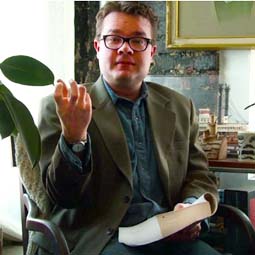
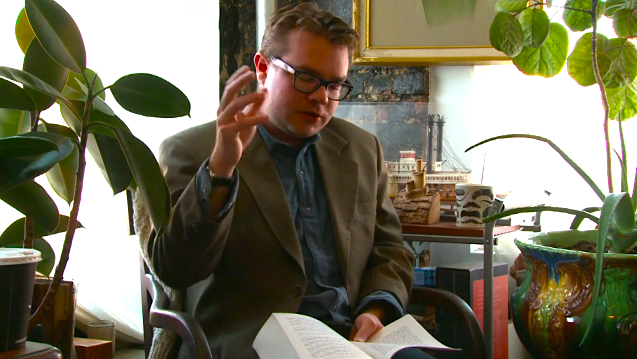
Benjamin Hale reads an excerpt from his debut novel, The Evolution of Bruno Littlemore. In this scene, chimpanzee Bruno first encounters primatologist Lydia Littlemore.
1 of 1


Since Genesis, loss of innocence by bait has been a literary motif with overwhelming referential power. Even before Milton, Christian philosopher and theologian St. Augustine (354-430) created a parable of sin in his Confessions by recounting a thievery of pears: "I dined on the crime itself."
In this selection from The Evolution of Bruno Littlemore, narrator Bruno's ending quip paraphrases The Love Song of J. Alfred Prufrock (1915)—an anguished poem of the modernist style published by critic, playwright and poet T.S. Eliot (1888-1965), an avowed "Anglo-Catholic." Unlike Eliot's timidly elegiac speaker, Bruno's response to forbidden fruit is bold; the first of many actions that propels his character towards individuation. As Bruno learns human speech (“Like Satan, I made myself with words”), the autodidactic chimp comes to assess himself alongside all the bad boys of the biblical-allegorical canon. Cited: St. Augustine, "Book Two: Sin." Confessions. Trans. Garry Willis. New York: Penguin Classics, 2006. p. 34 |



