




FORTNIGHT ISA MULTIMEDIA DOCUMENTARY PROJECT ON THE MILLENNIAL GENERATION: THE LAST GENERATION TO REMEMBER A TIME WITHOUT THE INTERNET. |

contributorsprofile
WINDOWS ON RAMALLAH

WINDOWS ON RAMALLAH
read the essay now>>
IN RAMALLAH, ANONYMOUS PARSES THE RHETORIC OF ACTING AS DEFENDER AND INTERLOCUTOR.
read the essay now>>

|
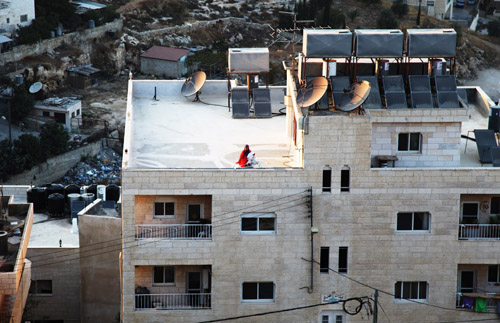
 Above: A Palestinian woman lays out her laundry on a roof terrace. It is the holy month of Ramadan. In a few hours, the city will fall silent as people break their fast. Free food will be served in a tent in front of my apartment block for iftar. So far, I have only seen men dine there. After they leave, local kids will come to play in the adjacent parking lot. I will go up to the rooftop terrace to watch the sunset. |
For the last few days, it has stained the sky bright pink. The contrast against Ramallah’s dully shaded, creamy-grey buildings is stunning. I am very fortunate to have such a high terrace. You can see a lot from up here. All the large mosques and churches are in view. Also visible are the reserve water tanks above the buildings. They serve the city’s inhabitants when Israel redirects water for itself from the shared aquifer. II I work for an international human rights NGO. It operates in over 40 countries and has four offices in the West Bank. Here, the organization provides legal assistance to children who have been arrested, imprisoned, or abused by the Israeli Defense Forces or the Palestinian Authority. A key component of my work is to compile accurate statistics on the number of children detained at any one time. At the moment, it is 284.I arrived in Ramallah one month ago. The city is teaming with foreign workers like me. There are six young European aid employees and journalists living in my block. We relax on our terrace in the evenings and exchange stories about our day. They are a great source of perspective. |

1/7
|
A quick conversation reminds me where public opinion lies in France, Germany, Spain, Greece, etc. I am in the middle of this conflict now, and that makes it hard to keep up with what the international community deems “the center ground.” The price of disobeying the Iranian government is very high, as I am sure you know, and as I will discuss in later posts. It should be clear, then, why I write anonymously for Fortnight. I was once asked to describe the mood back home to my new European friends. Everyone was all ears. I talked about Britain. They were expecting me to discuss Iran. Out of my two nationalities—Iranian and British—people find the former far more exciting. Middle Eastern politics, it seems, is more intriguing the further East you go.You can imagine the questions I am asked here: Is Ahmadinejad’s tough stance on Israel reflective of Iranian public opinion? What tangible support does Iran actually provide Palestinians? Does the Iranian regime use combative rhetoric to divert people’s attention from the country’s internal problems? Sometimes I am asked whether I am proud of living in Palestine as an Iranian. I usually say, “no.” |
The explanation is in my answers to the questions above, which I will not go into here. One thing I will say is that Iran prohibits its citizens from traveling to “The Occupied Palestine.” In “Iran-Speak,” that means Israel. Since Israel controls Palestine’s borders, this effectively bans entry into the West Bank. The price of disobeying the Iranian government is very high, as I am sure you know, and as I will discuss in later posts. It should be clear, then, why I write anonymously for Fortnight. III A few weeks ago, my friends and I were enjoying evening drinks in Ben Yehuda Street, Jerusalem. A mini explosion sent us running out of the bar and into the scramble outside. Everyone moved and interweaved so quickly. Before I knew it, we were one hundred meters away from the bar, and had forgotten to pay for our drinks.I am not a veteran of conflict zones. Only recently, I was in a slow-paced graduate degree and tied up with teaching at university. You can imagine, then, that it took me a while to collect myself outside the bar. Afterwards, I was feeling curious about life in Jerusalem. |
2/7
|
When we arrived at our hostel, I met a young Palestinian-Israeli called Adam. He explained that Arab-Israelis are consistently denied building permits in the city. The Israelis want Jerusalem to be a Jewish city, he said: If we are prevented from building here, we will have less space to have families. And prices, especially in East Jerusalem, will rise as more Jews arrive. Eventually, Arab-Israelis will be forced to move further east, until we are on the other side of the wall. Jews can build whatever they want. You have seen the skyscrapers from the Mount of Olives? All of a sudden, our buildings in East Jerusalem are illegal and we are in and out of court defending our rightful claim to our homes. Adam’s English was impeccable. I became curious about his life story. He had embarked on a medical degree in the United States but had to leave after two years. The Israeli government refused to renew his passport while he was outside the country, so he returned to Jerusalem to forward his application. Israeli citizenship is all he has. If he loses it, he will be stateless. When he arrived 18 months ago, he found that he was being slowly deleted from official Israeli records. |
First I noticed that my medical files had gone. I asked the doctors why and they said that this had happened to a number of their Arab patients who have left Israel. Then, at the embassy, there was no record of my request for passport renewal. It is humiliating. I was born in Jerusalem. I am a native Hebrew speaker. I went to school and university here. To top it off, my Jewish-American friends arrive in Israel and, a few months later, they are granted everything I have spent a year and half fighting for! I campaign for peace between Israelis and Palestinians. But the responsibility of making compromises, forgiving, and forgetting, falls on other peoples’ shoulders. As close as I may get to the injustices here, I am free to leave.IV Israel is a rich country, a melting pot of different cultures, and a bona fide member of the international community. But everyone’s eyes are on its back garden. In international politics, the occupation of Palestine is an open wound. Israel’s treatment of Palestinians is often compared to colonialism and South African apartheid. One can see why. Israel has occupied Palestine militarily for over 40 years. It applies two systems of law |
3/7
|
in the same area, where individuals’ rights depend on their nationality. It unfavorably regulates most of Palestine’s civilian, economic and legal affairs. Only 2.7 percent of the West Bank is governed independently by the Palestinian Authority. A barrier runs along the West Bank, which extends beyond the 1967 Green Line. It prevents Palestinians from entering both Israel and the Palestinian land that the barrier has annexed. In a 2004 statement, The International Court of Justice ruled that the wall is illegal. Israel continues to build settlements in the West Bank. Settlements are land grabs. They make room for Israelis to relocate. Some relocate for religious reasons. Others wish to benefit from government-provided financial incentives. Settlements foreclose the prospect of a viable Palestinian state by physically dividing Palestinian land and making it hard to govern. International intergovernmental organizations, like the European Union and every major organ of the United Nations, including the International Court of Justice, have declared that settlements violate international law. |
 Above: An Israeli settlement as seen from the Israeli side of 'Check Point 300', near Bethlehem. V Apartheid is a legal concept. It is defined in Article 7 of the Rome Statute of the International Criminal Court. John Dugard, an ad hoc judge of the International Court of Justice and the United Nations special rapporteur for investigating the state of human rights in the Palestinian territories, avers that Israel is guilty of the crime of apartheid, as a matter of law. Many international lawyers reach the same conclusion—that is, that Israel is an apartheid state, whether or not its apartheid resembles South Africa’s. |
4/7
|
Some of my British friends, who are lawyers, concur with this judgment. But they are uncomfortable comparing Israel to South Africa. Is the comparison intellectually lazy? Perhaps it overlooks the complexity of the situation. Israel's human rights record and settlement policy warrant criticism. But, according to Israel, the rationale is security, not racism and discrimination. Some people argue that this is evident in the rights Israel affords its Arab citizens. They can vote, serve in the Knesset, go to the same beaches and restaurants as Jews, travel on the same trains, buses and taxis, visit each other’s homes, and so on. None of this was possible in apartheid South Africa. Is it, then, misconceived to compare Israel and South Africa? But they are uncomfortable comparing Israel to South Africa. Is the comparison intellectually lazy? Or, perhaps the analogy is unpopular because it leaves little room for excusing Israel, or because people are worried of finding themselves in the same corner as political radicals and Islamic extremists.Consider the people who have leant their weight to the South African apartheid analogy. It is staggering: Ehud Barak, the current Israeli |
defense minister and deputy prime minister, also the prime minister of Israel from 1999 to 2001; Ehud Olmert, the prime minister of Israel from 2006 to 2009; Hendrik Verwoerd, the prime minister of South Africa from 1958 to 1966 and the architect of South Africa's “grand apartheid” Bantustan policies; Jimmy Carter, the president of the USA from 1977 to 1981; Miguel d'Escoto Brockmann, the president of the United Nations General Assembly from 2008 to 2009. The list goes on. A few months ago, in an open letter to the University of Berkeley, Archbishop Desmond Tutu wrote about the situation in Palestine: I have been to the Occupied Palestinian Territory, and I have witnessed the racially segregated roads and housing that reminded me so much of the conditions we experienced in South Africa under the racist system of Apartheid. I have witnessed the humiliation of Palestinian men, women, and children, made to wait hours at Israeli military checkpoints routinely when trying to make the most basic of trips to visit relatives or attend school or college. And this humiliation is familiar to me and the many black South Africans who were corralled and regularly insulted by the security forces of the Apartheid government. |
5/7
|
I am sympathetic to the South African apartheid analogy. But sometimes it is unhelpful. Back in the UK, I rarely discuss it. The debate is too charged. People switch off. It is easier to just say what you have seen. Whoever spends time here can observe which way their sympathy swings and make up their own minds. The first cut came at 22.30. It lasted ten minutes - enough time for me to run to the terrace and catch a beautiful view of the city shrouded in fog and darkness. Perhaps Daphna Golan-Agnon, the co-founder of B'Tselem, an Israeli information center on human rights in Palestine, sums it up best.I'm not sure the discussion about how we 'Israel' are like or unlike South Africa helps move us forward to a solution. But the comparison reminds us that hundreds of laws do not make discrimination just and that the international community, the same international community we want to belong to, did not permit the perpetuation of apartheid. And it doesn't matter how we explain it and how many articles are written by Israeli scholars and lawyers—there are two groups living in this small piece of land, and one enjoys rights and liberty while the other does not. |
VI Last night, there were two power cuts in Ramallah. The first cut came at 22.30. It lasted ten minutes—enough time for me to run to the terrace and catch a beautiful view of the city shrouded in fog and darkness. The second cut came one hour later. Everything in my bedroom disappeared, except for the glow-in-the-dark stars stuck to the ceiling, which I had not yet noticed. I was engrossed in Lewis Carroll’s Through the Looking-Glass when the lights went out. I continued reading using the light from my mobile phone. After about 15 minutes, I dozed off.I woke up in the morning to find there was no running water in my apartment—no drink, no shower, no toilet. “This is the third day in the row!” I told my landlord. What was his response? “You know the four settlers Hamas’ military wing killed last week near Hebron? Israel is collectively punishing us by cutting our water supply!” Friends in Israel say he is having me on. Who to believe?  |
6/7
| Ramallah, Palestine. An Oxford trained British-Iranian, the 7th Fortnightist maintained anonymity while publishing for Fortnight, due to restrictions on Iranians in the West Bank. His work for Fortnight was detailed in Blackbook Magazine and on several blogs. One of his pieces was republished by the Oxford University alumni press. After Fortnight he collaborated with Fortnightist Drew Zimmer. |
7/7




