


FORTNIGHT ISA MULTIMEDIA DOCUMENTARY PROJECT ON THE MILLENNIAL GENERATION: THE LAST GENERATION TO REMEMBER A TIME WITHOUT THE INTERNET. |

contributorsprofile
PRIORITY DISPUTE

PRIORITY DISPUTE
LAB RESEARCH STARVES THE CREATIVE MIND.
NINA FINDS THAT SONG SOLVES DRY ISOLATION.
read the essay now >>
LAB RESEARCH STARVES THE CREATIVE MIND.
NINA FINDS THAT SONG SOLVES DRY ISOLATION.
read the essay now >>


|
The most interesting moments in the history of scientific and mathematical pursuit have chiefly concerned what we call “priority disputes.” These are trials of who created or thought which innovation first. Famous examples range from the discipline of calculus (Newton vs.Gottfried Leibniz), to the conception of evolutionary principles (Charles Darwin vs. Alfred Wallace). Today, research practitioners are expected to apply constant, minute attention to their work in order to secure credit for a potential timely discovery. Day in and day out, the scientific process is a focused and introverted pursuit, requiring of its devotees long hours spent in dim-lit rooms. While it is gratifying to execute a successful scientific experiment and collect meaningful data to share with my colleagues, I sometimes find myself in a state of cognitive dissonance. While it can be argued that some abstract thought goes into experimental design, there is ultimately no room for self-expression in laboratory research. Unlike with art, the key to good science is using and maintaining monotonous conditions. Experimental results must be documented clearly so that they may be replicated step-by-step by anyone testing the same hypothesis. The experiments that I perfect and publish should be repeatable by scientists across the globe, as |
long as they use the same reagents and conditions I have detailed. So it should come as no surprise that I have come to find that the pursuit of science creatively stunting. I’ve only recently begun to break through this limitation by learning and performing music. Specifically, I sing. I opted for beginning chorus with the rest of the geeks. My creative endeavor was never intentional. When I attended public middle school in gulf-coastal Florida, the curriculum required I select of one of three elective courses: gym, band, or chorus. This period of my life I now refer to as “the braces years.”The orthodontia my twin sister and I acquired, and bore nobly throughout these years, was socially limiting. This awkwardness, compounded when changing clothes for gym in the humid Florida heat (it did not help my twin sister and I were outfitted and groomed the same until the sixth grade; doubly-dorky), meant I could really only choose enrollment in band or chorus. With no instrumental prowess, I opted for beginning chorus with the rest of the geeks. |
1/4
|
A peppy, tyrannical and middle-aged woman, Mrs. Z, led the class. We learned watered-downsegments of the popular songs of yesteryear strung together, sung in four-part harmonies and accompanied by light choreography. Choral showcases would be performed at afterschool functions for parents and family, and, during school hours, at places like retirement homes. Upon arrival to the class, all students had to take their shoes off for the choreography lessons of the day, making the room smell of feet and the strange odor of developing adolescent bodies. This was where my talent was realized. I was placed in the alto section, and soon found out that I could in fact carry a tune. My second year of middle school, I progressed to the advanced level class, bypassing the intermediate group. Of course, the advanced class had many privileges that the lower classes did not. For instance, the costume worn by members for scheduled performances consisted of a white, starched, pleated dress shirt, tucked into black dress trousers, complete with a black vest with silver inlay over the shirt, and a cummerbund (penguin/cocktail waiter look); far more fancy than the maroon or white polo shirt and dark trousers worn by lower classes. Perhaps the highest privilege was that the |
advanced group took a field trip to perform at Disney World at the end of the school year. Somewhere in existence, there are tapes recorded by a chaperoning parent of these performances with me in them for the two years I participated. Somewhere. Though originally only the lesser of three evils, over time I actually started to enjoy chorus class. I could have cared less about the choreography. The vocal lessons were what really interested me. I particularly like reading music, and focusing on pitch and harmony. I always auditioned for solo vocal segments in each showcase, but never was chosen. I actually was usually given speaking parts that introduced a section of songs. Usually, the more attractive girls won the singing solos. The subtle resentment I felt was perhaps one of the reasons I did not continue taking chorus when I began high school.It’s not that I totally abandoned singing, but it became dormant within me. My junior year of college, I met a young man named Milan McAlevey. Ten years prior to our introduction, Milan had dropped out from my alma mater during his first semester of his senior year to pursue the path of professional singer-songwriter.He showed me his dorm room record record collection: Brazilian tropocalia compilations, New Order, the Ethiopians…. I was smitten. That night he asked me if I would like |
2/4
|
to sing in a band he was forming; I said yes. Two years later, I live in Maine with Milan and work at Jackson Laboratory. Our sound is evocative of 1960s drug rock - somewhat akin to the Velvet Underground. Milan and I began recording demo tracks on a TASCAM analog 4-track tape recorder in our living room. At first, I only had backing vocals to Milan’s lead vocals and guitar playing. Over time, this collaboration grew into an actual project and I was incorporated as lead vocalist in some songs. It was at this point that we started playing gigs in Maine and New Hampshire. The chemistry and sound of our fledgling band was not complete until three additional musicians joined: Caleb Davis on second guitar, Carl Davis on bass, and Pete Cuffari on drums. The band is called Coke Weed, and our sound is evocative of 1960s drug rock—somewhat akin to the Velvet Underground.My personal influences for my vocal style are Rita Lee, Grace Slick, and Françoise Hardy. A major component of performance art of any kind is projecting a persona. Over time, I have overcome, and worked on developing an onstage persona. This was initially hard for me, because I am normally very reserved; however, it has become something that I really value. My job is so selfless |
at times that having the sharp contrast when performing really equalizes me. It is as if there are two versions of me: studious, quiet, empiric scientist Nina, and loud, psychedelic lead-singer Nina. At the lab recently, I was conversing with an older colleague on my involvement in Fortnight and the cross-generational concept behind Fortnight. One of his remarks really resounded with me. He commented how for my generation, unlike his, it is more possible and readily acceptable to have multiple professions—or, in his words, “wear multiple hats.” His millennial son, for instance, was in the sixth year of his graduate thesis, but in his spare time completed an unrelated novel about basketball. In my case, I straddle two worlds. During the week I wear my scientist hat, but in my spare time transition into a musician or singer hat. At this point in my life, I value and enjoy my scientific career. But, for reasons previously explained, it doesn’t completely satisfy all of my faculties. Producing and performing completes the rift I feel while I wait to feel ready to commit to the next step of furthering my traditional career.I’m still discovering what it is that I want to accomplish and achieve in my life, including how to prioritize my skills development. In the meantime, I’m going to take life as it comes, and enjoy finding riffs as much as I enjoy using reagents.  |
3/4
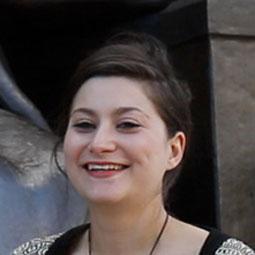
| Nina lives and works in Bangor, Maine. She is a research scientist at Jackson Laboratories, a genetics lab. Fortnight was the first journal to publish her essays on immunology and breeding mice to identify cancerous defects. Nina continues to work at Jackson Laboratories, and has now co-authored papers published in top science journals, such as Nature Immunology. She splits her personality between science and music, as described in her work on Fortnight. Her band, Coke Weed, recently recorded and released their second album and will be opening on tour with The Walkmen. She says of her time with the journal, "I stand for everything the Fortnight mission embodies; I believe that our 'millennial' generation has all the tools to profoundly change our world as we know it. I feel honored to be among the ranks of my fellow fortnight contributors, and hope that my essays will inspire others as they find their own path in this dynamic world." |
4/4




