



FORTNIGHT ISA MULTIMEDIA DOCUMENTARY PROJECT ON THE MILLENNIAL GENERATION: THE LAST GENERATION TO REMEMBER A TIME WITHOUT THE INTERNET. |

contributorsprofile
THE FUTURE

THE FUTURE
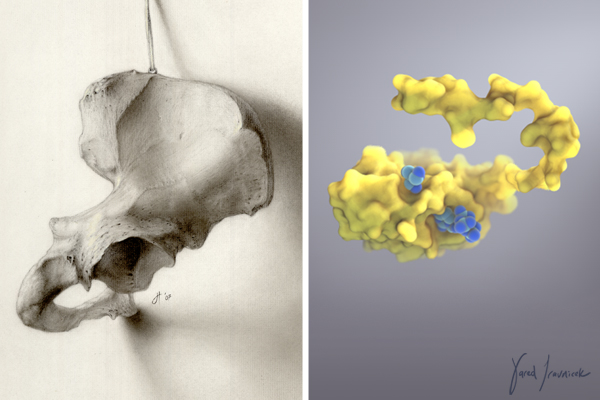
PENCIL CONCEDES TO PIXELS:
JARED INTERVIEWS HIS COLLEAGUES ON
THE FUTURE OF MEDICAL ILLUSTRATION.
READ THE ESSAY NOW >>
PENCIL CONCEDES TO PIXELS:
JARED INTERVIEWS HIS COLLEAGUES ON
THE FUTURE OF MEDICAL ILLUSTRATION.
READ THE ESSAY NOW >>


|
What’s in a name? Now that we as a profession have branched out from traditional illustration, some people don’t feel as though "medical illustration" truly describes what they do. Should we still be called medical illustrators? Can we find a better identity in a title like "biomedical communicators," or "scientific visualizers"? I posed these questions to a group of individuals whose responsibilities cover fields from illustration and animation, to interactive and game design. |
What are your primary responsibilities, and do you think the name "medical illustration" accurately describes you in your current position? David Ehlert: At Cognition Studio, Inc., where I am the Co-Founder/Director of Illustration, my primary responsibility as a medical illustrator is comprehending the intended message and target audience of each and every client and then translate that message into a visual story that teaches, enlightens, or in some cases, entertains.  David Ehlert Medical Illustrator: 14yrs AMI member: Yes, 13yrs |
1/9
|
lot of exciting work going on and it's a tough juggle with work, but it's worth it. Lastly, "medical illustrator" is fine for what I do, but I actually prefer Biomedical Illustrator for the most part, because it bridges my love for biology and medicine as applied to art. ***  Jeni Fairman Medical Illustrator: 14yrs AMI member: Yes, 14yrs Along with my creative duties, I also teach in the Graduate Program at JHUAAM. Most of the classes |
I teach cover digital techniques such as raster and vector illustration, 2D animation and web animation and interactivity. I also team teach Operating Room sketching, surgical illustration and business practices. Each year I act as thesis advisor to at least one student – this year, it’s two! The name “medical illustrator,” as a general term, is a pretty accurate description of what I do. I often use the term “biomedical illustration.” ***  Thomas Brown Medical Illustrator: 6yrs AMI member: No
|
2/9
 Jodi Chapman Medical Illustrator: 6 mo. AMI member: Yes, < 1 yr. *** Bill Westwood: In my first job at the Mayo Clinic, I did anatomical and surgical illustration, as well as many other things, from “slide/tape” programs for patient education to 3D anatomical & surgical models to designed large exhibits. I also developed |
and made working prototypes of various medical devices and received a patent on one such device. Bill Westwood Medical Illustrator: 40 yrs. AMI member: Yes, 37 yrs. |
3/9
|
The name "Medical Illustrator" has always described me professionally. It is what I am – and to a large degree, who I am.
***  Nick Klein Medical Illustrator: 2.5 yrs. AMI member: Yes, 3 yrs. The term "medical illustration" is a convenient way for us to explain our value-added as a company. We specialize in engaging storytelling through interactive technologies, but what makes our work so effective is that we have a deep understanding of the science, and we know how to package it for a specific audience. These skills come from our formal training, and inherited legacy, as medical illustrators. *** |
 Cory Sandone Medical Illustrator: 25 yrs. AMI member: Yes, 26 yrs. I think the term "medical illustrator" is a good term for what I do. I also tell people I am a faculty member, which covers most of the other things I do, but when I have to use one term, I use "Medical Illustrator". *** Donny Bliss: I work in a research unit that explores visualization and animation tools to better communicate complex science and health data. |
4/9
 Donny Bliss Medical Illustrator: 20 yrs. AMI member: Yes, 21 yrs. II Do you think that medical illustration is an appropriate description for our profession as you see it today and if not, what name or names do you think best describe what we do?David Ehlert: For some, yes. But for others within this diverse field, the term "illustration" may be misleading or unrepresentative of the work they do (e.g., modelers, animators, etcetera). I like "Biomedical Illustrator" or "Biomedical Artist" for those who mostly draw, and "Biomedical Modeler" or "Biomedical Animator" for those who do that kind of work in the biomedical field. It's like a Biomedical Scientist—someone that is a scientist trained |
in biology with a focus on medicine. In comparison, we're illustrators, modelors, and animators trained in the arts with a focus in biology, particularly in the context of medicine. Works for me. Jeni Fairman: What are we? Artistic scientists, or scientific artists? What disciplines do we cover? Science? Medicine? Public Health? Ignoring what we call ourselves within our profession, I have often contemplated what it is that I do, and what we do as a profession on a day-to-day basis. When we look at our duties close-up, it is impossible to come up with the perfect label. For example, some days I am just debugging code in PHP. Does that make me a “programmer”? No. What are we? Artistic scientists or scientific artists? What disciplines do we cover? Science? Medicine? Public Health? But if we take a big step back and ask ourselves, “What is it that we are here for? What do we contribute to society?” the answer I always come back to is that we “teach.” Are we then artistic science teachers?On one hand, I find the word “medical” to be somewhat limiting. I often use the term “biomedical” so as to include science outside of medicine. On the other hand, I find the word |
5/9
|
“illustrator” to be very meaningful and much more descriptive than one might expect upon first impression. Many think of the lay meaning of “illustrator” to mean artist, or one who draws pictures. But, in fact, I find it to be much different. An illustration’s soul purpose is to teach something. If it doesn’t teach, then it is simply a drawing; an expression of the artist; a work of art. An illustration can be more than just a pretty picture. It can have word-story, it can have movement, it can even be physically 3-dimentional. In fact, not all illustrators are artists. Some of the most successful ones I know are scientists. I think we need to move away form thinking of the layman’s definition of the term because it is simply inaccurate. Illustration can be visual communication (eg. biomedical visual communication, or biovisual communication). I much prefer to use the correct etiology and term to label myself, rather than use the proper definition. If not medical illustrator, then biomedical illustrator is the only alternative I have been able to settle on so far. Thomas Brown: I think JHU's "Art as Applied to Medicine" and UT's "Biomedical Communications" titles do a fine job defining the broad range of disciplines in which a medical illustrator may work. "Medical Artist" is a simple succinct umbrella term often used as a lump title. Beyond this, I find |
it is necessary that our titles be more defined. Otherwise we face confusion with clients and coworkers, and we undermine the diversity and functionality of our specialized field. Medical illustrators (or artists or communicators) are detail-oriented. I find it ironic that we would place our refined skills under such a loose banner. I believe that the more we are accepting of our diversity, the more we will see growth in both our shared creativity and relevance in society. Jodi Chapman: While it is the most widely recognized description of our profession today, I do not believe medical illustration is an appropriate description for the range of expertise and abilities of those in our profession now and in the years to come. In coming up with my own job title, I chose “medical illustrator” because it was the most familiar to me at that time, being new to the AMI, and to what I had done in school. However, I see the need for change. Although we use a range of media, those in our profession are communicators of science, creating accurate and informative visuals to improve our understanding of medicine. I think “biomedical communication” describes both the subject and medium in our profession well. Within that umbrella can be more specific titles like animator, illustrator, writer and director, but communication should be the thread, and the title, that all binds us together. |
6/9
|
Bill Westwood: I do think that the term “medical illustration” is an appropriate description of what we do in our profession today. We illustrate – in one technique or another – medical subject matter, either grossly or at the cellular or subcellular level, in still or motion media. Some people within the AMI feel that the name “medical illustrator” doesn’t adequately describe our diverse skills, put enough emphasis on our interdisciplinary scientific problem solving abilities or include all of the preclinical science some members illustrate (e.g., biology). However, I believe that there isn’t a “perfect” name for individuals with our unique and specialized education, skills and capabilities. Historically, medical illustrators have always worked beyond their name descriptor. All of the names proposed to date (e.g., biovisualization or biomedical communication) are more generalized and vague (in my opinion) and run the risk of becoming quickly outdated themselves. Rather than “throw the baby out with the bathwater” by changing our name—and the 100 years of brand recognition that goes with it—we need to take control of our brand, coordinate it with an updated mission statement and then fully and ambitiously promote it to the decision-makers in the current and newly emerging markets in which our members work. Literally tens of thousands of physicians, attorneys, art directors and other current and past clients in existing |
medical illustration markets already have significant knowledge about who we are and what we do. We need to build upon that brand recognition—not naively throw it away and try to start from scratch. Nick Klein: I used to think this term was archaic and self-deprecating, since "illustration" is just one of the many things our profession is doing right now. However, in a broader sense, any act of visual storytelling with the intent to elucidate, educate or modify behavior could be described as illustration. In that way, it is an excellent term that separates us from other media creators. The bottom line is that "medical illustration" is probably not the best way to describe ourselves to the world without context, but it is a term that serves us well when framed in a conversation about the valuable skill set it describes. Cory Sandone: Yes, I think medical illustration is an appropriate description for our profession because it can be interpreted broadly and has a solid history. The tools change, the platforms for delivery change, but visual problem-solving remains the constant valuable skill our profession provides when clarifying and elucidating medical content. I think 67 years in the history of a professional organization is significant. We have a solid foundation (and name) with positive |
7/9
|
connotations we can build on. It is fun to think of new names, but I'm concerned that if my response is "biomedical visualization expert" or "scientific anim-illustrator" or some other term that tries to capture all we do today (and not necessarily tomorrow) it will add confusion and be a conversation stopper. I'd rather have someone ask, “Is there still a need for that?” when I say I’m a medical illustrator than have them change the topic, because I use a term they think is some fringe occupation they've never heard of. Two examples come to mind when reconsidering a name change: Radiology and Adobe Photoshop. Two examples come to mind when reconsidering a name change: Radiology and Adobe Photoshop. Radiology is no longer just X-rays; it now includes CAT, PET, MRI, and ultrasound. The original "Photoshop" term implied a rather limited activity: adjusting photos, but everyone understands that it is used for much, much more. It is a recognizable term that acts as a great umbrella. The term medical illustration has been our organization’s umbrella since its inception and the meaning has been evolving all along. I think the name of our professional association is an asset that should be preserved! |
Donny Bliss: When many of the best animations and graphics are coming out of scientific groups without medical illustrators, it may be that the world’s definition of medical illustration is already shrinking. What we see as the ever-broadening field of medical illustration needs a name that will embrace visualization scientists. I find good arguments on both sides of this discussion. In my current position, 95% of what I do revolves around illustrating (starting with pencil and paper) surgical procedures. I do some animation and interactive work, but for the most part, medical illustration is a great definition for me right now. After going through the responses, I have come to the conclusion that there is no one perfect name to describe what we do. We have a valuable skill set that spans multiple disciplines. However, in the end we all share the goal of communicating medicine and science in an effort to educate. I think that medical illustration as a term can seem a bit dated, and while it may not describe all the facets of what we are capable of, it does offer (using the definitions of its terms) an umbrella under which our profession can evolve. We may need to be more precise when discussing our individual positions, but I think that discarding the term medical illustration could be |
8/9
problematic. It seems to me that gaining mass recognition for medical illustration is an uphill battle. The unique nature of our profession does not easily lend itself to simplified descriptions, but I think medical illustration in a good place to start the discussion.  *** Jared Travnicek is a medical illustrator based in Indianapolis, Indiana. He holds a Master of Arts in Medical and Biological Illustration from the Johns Hopkins University School of Medicine, and a BA from Iowa State University in Biological and Pre-Medical Illustration. Jared is an award-winning member of the Association of Medical Illustrators. He currently works as a neurosurgical illustrator at Goodman Campbell Brain and Spine.His previous pieces for Fortnight are biographical sketches of Max Brödel and Dorcas Paget, two pioneers of the field of Medical Illustration. To view more of Jared's original illustrations, visit jtsciencevisuals.com. |
9/9




