




FORTNIGHT ISA MULTIMEDIA DOCUMENTARY PROJECT ON THE MILLENNIAL GENERATION: THE LAST GENERATION TO REMEMBER A TIME WITHOUT THE INTERNET. |

contributorsprofile
MUSK OXEN & LITERATURE

MUSK OXEN & LITERATURE
THE LITERATE HERDER PERCEIVES MOTIF.
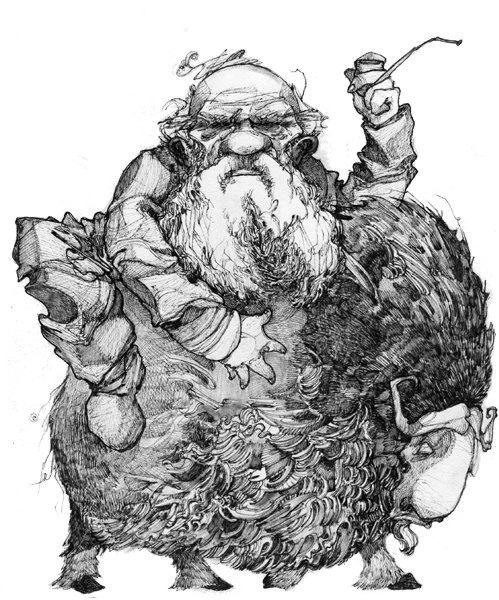
GUNNAR ANALYZES TOLSTOY'S MEN & BEASTS.
Read the essay now >>
THE LITERATE HERDER PERCEIVES MOTIF.
GUNNAR ANALYZES TOLSTOY'S MEN & BEASTS.
Read the essay now >>


To my knowledge, there are no musk oxen in literature—and I can assure you that musk oxen hold little interest the classics. In my reading, Psyche’s approach to collecting the fleece contrasts with Jason’s as the difference between feminine and masculine approaches to heroic conquest. Psyche successfully secures the fleece by sneaking into a pasture of the dangerous rams at noon as they take their midday nap. She plucks the fleece from the brush in which it is entangled. Psyche’s method entails no contact with the animals, with nature, or with the wild–it is completely passive. Teal's equation of her method with the development of musk ox |
husbandry is therefore a stretch, from my perspective. While we musk ox husbands may strive to collect our golden fleece with the subtlety and guile of Psyche, we undeniably confront bearers of the fleece upon the most intimate and direct terms. The “rams” of musk ox husbandry are quite aware of we fleece collectors’ austere presence. On my first attempt to lasso To better illuminate my vocation in literary metaphor, I prefer to evoke two episodes from Tolstoy; the hunt scene in book seven of War and Peace, and the mowing scene from part three of Anna Karenina. These scenes do not simply mark the transition from hunting to an agrarian society. They also hold personal significance to me.an injured yearling... On my first attempt to lasso an injured yearling in the midst of several seasoned bison ranchers, I found myself vividly recalling Levin’s effort to keep pace with peasants mowing with a scythe. As I’ve walked the pastures in the early morning when the grass is still glazed in frost, to survey whether the herd is near molting their qiviut, I envision myself as Rostov being called to the hunt by the clarity of a fall morning. Prior to my experience with the oxen, I was first a philosophy major who reread Tolstoy |
1/4
|
for “fun.” These scenes not only proactively informed my later herding, but also at times almost dictated my approach. Oddly, in this way, art shaped nature. Russian aristocrats hunting wolves do not equate to working Americans herding bull musk oxen, but Tolstoy’s transcendent depictions of man’s relation to the natural world nonetheless moved me. Tolstoy has in fact been used before in reference to domestication. In a chapter nine of Guns, Germs, and Steel, titled “Zerbas, Unhappy Marriages, and the Anna Karenina Principle,” academic Jared Diamond wrestles with how and why domestication happened, as well as the impact of domestication upon civil society. Diamond outlines six principles he deems necessary as precursors for domesticating a wild animal; musk oxen possess all eight. As for literature, I find it to be my saving grace. Literature gives me solace—a chance for reflection, and an emotional shelter from the berating effect of the ruggedness of Jack London’s north upon my soul. Cultural perspective upon one’s vocational activity is not accessible during the physical experience of ranching and taming. While London's To Build a Fire echoes a profound truth about the nature of wild instinct, I have found literature to be the convex to this concave truth. For as much as Tolstoy touts the triumphant harmony of nature, it |
goes without saying that the complex cultural activity of literature meant something to him, too. My claims to being literary are nil, but I feel secure to say I’m no greenhorn to the wild north, and thus speak to matters of the natural world with some authority. Tolstoy depicts a primordial connection to the wild aspect of the human soul. Both the hunt scene and the mowing scene convey a strong unity between nature and culture; land and man. These scenes create profound harmony and order between two worlds whose interplay is otherwise often portrayed by writers as chaotic. By my reading, the momentary harmony Tolstoy depicts arises in the coincidence and alignment between the natural world and labor. There is a primordial connection to the wild aspect of the human soul. The contest between the pack of hunting borzoi and hunted wolf could be understood as the tension between the domestic and the wild.Most fundamentally I find one difference between these scenes to be that hunting is an activity of leisure, while mowing is clearly an activity of labor. Musk ox husbandry cannot easily be considered either. To work with musk oxen, one must contend with the natural elements and the animals’ stubborn wills—but nothing about it as labor- |
2/4
|
intensive as swinging a scythe. And, not to bash many of our farm’s volunteers, but I have not ever found myself wandering the pastures to herd during my leisure hours. Even more paramount to my personal interest is whether musk ox husbandry—or farming generally—contains within its execution the ability to produce that elusive harmony so vividly portrayed by Tolstoy. Does a vocation with an intimate connection to the land satisfy an elemental need within the human soul? Does a vocation with an intimate connection to the land satisfy an elemental need My time herding oxen has undoubtedly contained within it fleeting moments of clarity—moments that, without much of a stretch, I could say are times when I unexpectedly strike a harmony with my surroundings. However, I would not pretend this to be the general state of affairs in working with musk oxen. For every moment of harmony in the pasture, there are several hours of frustration with stubborn cows, a falling-down fence or disordered stanchion parts. What I find myself searching for in Tolstoy are artfully-rendered moments to cherry-pick for translation into the tangible world.within the human soul? |
Yet at the end of the day, musk ox husbandry lacks one key ingredient within Tolstoy’s scenes: an established cultural tradition. The hunting scene is laced with tradition so thick that in reading it, one can almost feel like a Russian peasant living on the steppe in the nineteenth century. Nastasha howls with the wolf, completely absorbed by the natural world. She dances a traditional peasant dance although she does not know as though its steps, implying that the movement runs through her blood and is stamped within her genes. I’ve snorted at musk oxen and run at the head of little brat-packs of calves as though I was their senior, and perhaps shared in some small piece of the musk ox’s experience of the world. Yet, the tradition of musk ox-ing is nil. If anything, it is one of the most brass attempts to forge new tradition within rural Alaska that there has even been. I can lay as much claim as any other herder to have created what little tradition there is of musk ox herding. Thus, if Tolstoy is right—which I am inclined to think he is—and somewhere deep within my Babcock blood runs some deep-rooted Scottish culture, how am I to find it nearly ten thousand miles away, upon Alaska’s frozen landscape? |
3/4
|
As to an answer for this question, I am at a loss. Unlike Rostov, who sets out upon the hunt on horseback with his ancient borzoi (like the all Rostovs before him had done, upon the same stretch of Russian land), I am left out in the Alaskan cold. I do not have engrained within my genes some agrarian, qiviut-combing satisfaction. I am, at the end of the day, a first-generation Alaskan (actually a rarity there, in the land of transplants). As I tally the qiviut combed, having dusted off the old scale, I assess my labor but am left with a void. While I could say my activity is just as tangibly useful as Levin’s looking over mowed fields as the sun sets overhead, I do not have engrained within my genes some agrarian, qiviut-combing satisfaction. And more so, as my true work is that of domestication, there is no mark or measure by which I might survey the progress (or lack thereof) my labor has made. The measure of domestication is taken in decades, not days, and its ultimate success is far beyond the scope of my sight. Thus, by Tolstoy’s account, my prognosis for harmony—and that of musk ox herders—is bleak. |
But I just might have one element lost on Tolstoy’s characters. Musk ox husbandry brushes up against the wild in a way not found in the cyclical existence portrayed by Tolstoy. Rostov and Levin do not seek to tame, but are tamed. The tools carried by the herder of musk oxen forge new pages in agrarian history—something I suspect hunters and farmers have not done for many thousands of years. Chaos still exists in force within the ox, and there is a deep satisfaction to be had for those willing to tame it. Otherwise, my longing for harmony must continue to be sated on the vast plains of art.  |
4/4

The qiviut (pronounced “ki-vee-oot”) is the underwool of musk oxen. Qiviut keeps these animals warm at negative 60 degrees Fahrenheit on the arctic tundra, when there is nothing to subsist upon other than the sparing lichens found several feet under the snow. Their qiviut beards have allowed the musk oxen to survive for several millennia where few other species have managed.
For more on quiviut, see: Among the Oxen




