


FORTNIGHT ISA MULTIMEDIA DOCUMENTARY PROJECT ON THE MILLENNIAL GENERATION: THE LAST GENERATION TO REMEMBER A TIME WITHOUT THE INTERNET. |

contributorsprofile
CHILDREN & DEATH

CHILDREN & DEATH
AN EARLY ACCIDENT SPURS OBSESSION.
MORTICIAN CAITLIN DESCRIBES HER
FIRST ENCOUNTER WITH DEATH.
Read the essay now >>
AN EARLY ACCIDENT SPURS OBSESSION.
MORTICIAN CAITLIN DESCRIBES HER
FIRST ENCOUNTER WITH DEATH.
Read the essay now >>

|
There is a terror to childhood. You remember this terror even as an adult, including the way it hummed along like background noise over even the happiest of moments. It arrives in your single digits, around the time a child first begins to understand death. Our morbid little minds, not quite fully formed, are introduced to the many and varied opportunities for death that life has to offer. If she's not home, she's likely dead. Is that a police siren? Someone I love is dead, Lying on my back in the grass, staring up at the stars, I am positive an asteroid hurtles towards Earth to destroy all I hold dear. Curled up in bed, my eyes gaze out the window in search of my mother’s headlights. It’s already 9PM. If she’s not home, she’s likely dead. Is that a police siren? Someone I love is dead, lying on the side of the road. Why isn’t my dog coming when I call her? She is in the backyard, dead. That kid in my class has leukemia. I bet I have it too. I’m going to die. Death, death, death. I am eight, and the grim reaper has sat me down and said, “This is death. It’s awful and final and irreversible, but I’m not going to give you any context for it.” With death, context is important. Very important. And I don’t have any.lying on the side of the road. |
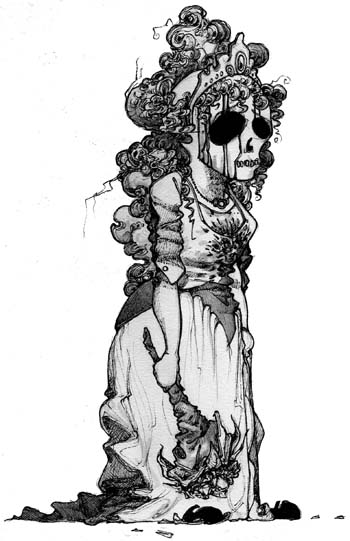
Joel Peter Witkin claims that one of his first memories was of a young girl being decapitated by a car outside his home in New York. I remember my first encounter. I was eight years old. I had entered a Halloween costume contest at my local mall. I was a dead prom queen, bedecked with a blue sequined dress, a straggly black wig, and copious fake blood. I lumbered and shuffled down the runway and won over the judges with my zombie monotone. My prize was $75, enough for an obscene amount of POGS. As I stood on the balcony, savoring my victory, a small girl climbed up onto a nearby railing, unbeknownst to her distracted mother. Her little body slipped over the side and hit a laminate counter below with a sickening thud. Her mother went shrieking down the escalator as the crowd swarmed the child in slow motion. That thud changed the course of my whole life, as if the girl had fallen deep into a pit of fear at the center of my body. There was no blood, no gore. I had seen worse on television. But this was reality. That girl was dead. Or at least I assumed she was. I never found out for sure. Not knowing was its own type of torture, like the pull on mother whose child is missing in action overseas. The night it happened I sat up until dawn, afraid to turn out the lights. My soundtrack was the monotonous thud playing on |

1/3
|
repeat in my mind. My parents found me the next morning in the living room. They took me out for chocolate chip pancakes. But we didn’t talk about death. Death rates were literally cut in half by medicine, nutrition and sanitation. The downside to this is that no one ever dies. Modern medicine is a double-edged sword. In the course of the 20th century, death rates were literally cut in half by medicine, nutrition and sanitation. The downside to this is that no one ever dies. Or at least it seems that way. As a mortician, I know that people die all the time. I have eight deceased I’m working on at work this week alone. But people constantly tell me that they have never even been to a funeral. One hundred years ago, by the time I was eight years old I would have seen my mother die, my childhood friends die, my neighbors die. I would have followed their wooden caskets to the grave. That’s the context of which I speak. Regular exposure to the idea of death was missing for me when I saw that little girl slip off the railing to her death.The minds of children are dark, dank, fecund little places. Dr. Earl Grollman, an expert on death and children, wrote that “unhealthy explanations can create fear, doubt, and guilt, and encourage flights |
of fancy that are far more bizarre than reality.” Our imaginations can indeed be far, far more powerful than reality. We create elaborate scenarios of the horrors that await us in our closets and under our beds. We can decide that grandpa “sleeping” really means he will wake up any second and be trapped underground in his casket. This is a type of imagination we often repress as we get older, when some bastardized form of “reality” sets in. As adults, we tend to forget the terror of childhood. My first year in the death industry was spent slowly peeling back layers of fear I didn’t even know were present. Leftovers from childhood. My first job in the industry was as a crematory operator. My first job in the industry was as a crematory operator. We would often cremate infants from the local hospital. One day, a mother came in to the funeral home to pick up the cremated remains of her one-week-old baby. She brought her other daughter, about four or five years old, with her. The little girl made faces at me as her mother signed the required paperwork. I made faces back—it seemed like the right thing to do. As I handed her mother the box of ashes, I wondered what this little girl’s memories of me would be. Where would this exchange fall in the spectrum of her childhood terrors? |
2/3
|
Perhaps she wouldn’t remember me at all, not quite old enough yet to understand the implications of what was in the box. Perhaps her mother had rationally explained to her what had happened: “Mommy’s baby died. That means you won’t have a little brother. It’s okay to be sad; Mommy’s sad. But sometimes babies die. He’s not in pain, he’s just not alive anymore.” But if mother was silent, kept her from the funeral and spoke in hushed tones with her just out of earshot, my face might become representative to that girl of the terror of childhood. It might trigger a trip to that place where machines roar, and her little brother was sent to the fires by a tall, scary woman. My face could be her sickening thud.  *** Caitlin Doughty is a licensed funeral director in Los Angeles, California. In addition to her mortuary science certification, she holds a degree in Medieval History from the University of Chicago. |
3/3




