




FORTNIGHT ISA MULTIMEDIA DOCUMENTARY PROJECT ON THE MILLENNIAL GENERATION: THE LAST GENERATION TO REMEMBER A TIME WITHOUT THE INTERNET. |

contributorsprofile
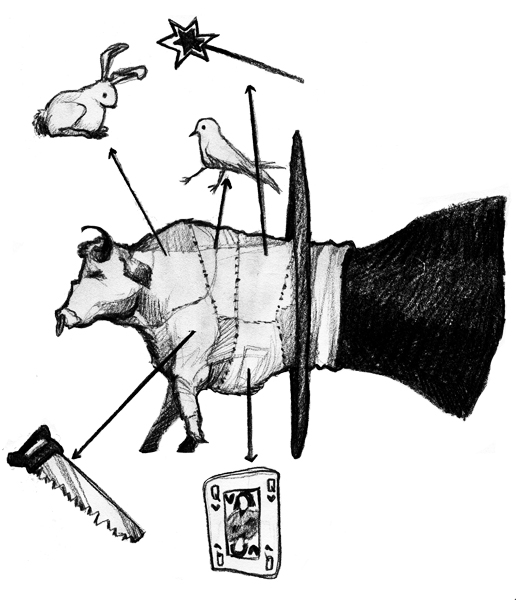
MAGIC FOR VEGETARIANS

MAGIC FOR VEGETARIANS
COMMON MAGIC DIETS LACK SUBSTANCE.
WATCH PRAKASH'S VIDEO MENU
OF MAGIC'S HISTORIC GREATS.
Read the essay now >>
COMMON MAGIC DIETS LACK SUBSTANCE.
WATCH PRAKASH'S VIDEO MENU
OF MAGIC'S HISTORIC GREATS.
Read the essay now >>


|
I am not a vegetarian–far from it, actually. I am aware of the adverse effects that the meat and factory-farming industries have on our environment, just as I have been gently lectured about the potential benefits of eliminating meat from one’s diet. Yet, I find myself prone more to indulgence than to abstinence. In my twenty-nine years of ambling the earth, I have not only consumed sizeable amounts of meat, but also maintained enough pretensions to consider myself an amateur on the subject. And so I often imagine the following scenario: A vegetarian seeks my counsel. “I have never tasted meat before,” she says. “Nor do I plan to make it a regular part of my diet. However, food being an entry to a culture, I’d like see what all the fuss is about and, at the very least, try enough meat to gain an opinion on the subject. So I want you to line up a series of carnivorous meals for me. Different dishes, different restaurants, different countries, different styles. We’ll start tomorrow.” What would I do? What should I feed her? It’d be tempting to only visit the best and cleanest steakhouses in New York but that would hardly constitute a broad variety, certainly not enough for an informed opinion; we’d also have to include tripe, chicken curry, roadside mystery meat, lamb rendang, grilled sweetbreads, bone marrow, satay, mutton soup, bakkwa and bacon. |
You seek my counsel. You are not a magician. Similarly, consider this scenario: You seek my counsel. You are not a magician. In fact, you’ve barely seen any magic before (except perhaps a snippet of Copperfield on television, or, god help us, a magic-clown at a cousin’s birthday party when you were nine years old). Still, you sense that magic and magicians seem more popular–more prevalent, more visible in the mainstream–than ever before, and you want to know what all the fuss is about. At the very least, you want to be able to talk briefly about the subject should it arise in conversation. And so you want me to prepare a line-up of magicians and magic-acts for your viewing; some on television, some live, and some remembered only via grainy video clips viewed on one’s computer screen.What will I do? What shall I show you? This isn’t, after all, meant to be a history lesson. Nor is it meant to be exhaustive. Nor, frankly, can I pretend that the mere watching of video clips will make you an informed consumer capable of intelligent commentary–it won’t, and to claim otherwise would be unfair to you. |
1/8
|
Magic, firstly, must be seen live. After all, it’s one thing to watch a man float in midair on television, and quite another to witness the same thing whilst in the same room. In the same room, as my partner Matthew is fond of saying, you know the rules; you know what can and cannot be done. Secondly, as is the case with every other art form, the watching of images should ideally be accompanied by the reading of words. And many a word has been written about magicians–not just about our lives and exploits, and certainly not merely about the way our tricks are done, but, more, about they way we think. How is it, after all, that a scientist can be fooled–amazed, even–by a card trick? Adam Gopnik’s recent piece in the New Yorker, titled “The Real Work,” would be an excellent place to start, as would Jamy Ian Swiss’s collection of essays, Shattering Illusions. Also David Ben’s Dai Vernon: A Biography and Karl Johnson’s The Magician and The Cardsharp. But we’re getting ahead of ourselves. After all, you wanted me to prepare a line-up of people and performances, didn’t you? Penn & Teller My favourite magicians in the world, and quite possibly the best magic show you’ll ever see; a |
show–a magic show–that not only deals with the topics of scepticism, atheism, knowledge and freedom of speech, but concurrently provides the audience with some of the most startling and memorable images they’re likely to experience. In one routine, “Silverfish,” droplets of water transform into silver coins, which in turn morph into live goldfish. In another, “Shadows,” a single rose in a vase slowly falls to pieces as Teller gently slices at its shadow. Together, their routines freely combine violence, gore, and wit to create something greater, more provocative and more beautiful than the sum of its parts. |
2/8
|
For example, when most magicians perform a card trick, the most exciting thing that might happen is that the chosen card might appear inside, say, your shoe. When Penn and Teller perform a card trick, Penn gets stabbed through the hand with a buck-knife. Or, alternatively, Teller drowns in a tank of water. (He doesn’t escape or disappear, mind you. He simply drowns.) |
Slydini As if there weren’t already enough reasons to love Dick Cavett, he recently devoted two of his columns in The New York Times to the memory of his friend and teacher, Tony Slydini. Dapper, crisp, and with an unforgettable voice, Slydini was a master of misdirection who not only fooled the living daylights out of magicians, but whose thoughts on choreography, movement and direction of attention still inform the work of close-up performers everywhere. Or this article, Conjuring Slydini, written by Dick Cavett. |
3/8
|
Cardini You’ve almost certainly seen magicians (specifically, stage manipulators) plucking endless streams of cards from mid-air and scattering them onto the stage floor, or shooting them out into the audience. When done well, it can be undeniably gorgeous. It is also, however, entirely lacking in conflict; the omnipotent magician desires a handful of cards, and so they appear. The beauty of Cardini’s act lay in its plot; a tipsy aristocrat stumbling into his sitting room at the end of an evening, only to be pestered by handfuls of cards, materializing at his fingertips of their own accord. |
John Scarne & Steve Forte It shouldn’t come as a surprise that many of the techniques and psychological principles used by conmen, pickpockets, charlatans and card cheats also form the basis of a good magic act. These tricksters all use deception in one way or another. Naturally, over the years, many magicians have explicitly employed these subjects in their work; either as the plot for a specific routine (in a performance of the three-shell-game, for example) or as part of their performing character. John Scarne, primarily a stellar magician and sleight-of-hand man, also fashioned himself as a gambling expert. He even lectured the military and navy on card-cheating and crooked dice. |
4/8
|
Steve Forte, conversely, is not a magician. He is, however, currently the world’s foremost expert on crooked gambling, cheating, and casino security. And, hyperbole aside, he probably has the best damn hands of anyone on the planet. |
David Copperfield The most commercially successful magician in history and one of the highest-paid entertainers in the world, with more tickets sold worldwide than any other solo entertainer and with a face and name known to people in almost every country in the world. The same, of course, might also be said of a Big Mac. Nevertheless, Copperfield remains responsible for performing some of the most beautiful, jaw-dropping illusions of the past few decades, and frankly, is also probably the reason why many of my generation first became interested in magic when we were kids. Everyone craves a cheeseburger from time to time. |
5/8
|
Dai Vernon Gentleman, sophisticate, the greatest sleight-of-hand artist of the 20th century, and the most influential magician of the 20th century, Dai Vernon changed magic for entire generations to come. Every magician currently performing today, whether on stage or close-up, and whether they know it or not, has been influenced by Vernon and his thinking; specifically, his constant quest for naturalism in magic – the abandonment of loud, bombastic gestures and movements in search of something subtler, softer, more persuasive, and more elegant. |
Tom Mullica I could tell you about Tom Mullica – magician, comedian, and a principal figure in the history of Magic Bar. More to the point, I could tell you about the act for which he is famous. But I shan’t. Watch this. Enjoy. |
6/8
|
Harry Anderson I wanted to be Harry Anderson when I was growing up, and I’m fairly certain that I wasn’t alone in this desire. It wasn’t just that he was snazzily dressed, sarcastic, and seemed to have a quick retort for apparently any situation; Harry’s personality also flaunted a seductive sense of jauntiness; a Bug Bunny-esque sense of mischief and don’t-worry-I’ll-be-fine jubilation. Del Ray What should a magician look like? The typical image of a magician, at least in fiction and, for a while, in popular culture, usually involved a well-coiffed head of hair, piercing eyes, and |
perhaps a goatee. Powerful though this may be, it does tend to become boring after a while; after all, if a fellow looks like a magician, you fully expect him to perform magic tricks – in much the same way that you would expect someone wearing a bunny costume to behave, well, like a bunny. But consider the converse: Someone who looks, dresses, and acts in the plainest of manners – someone who might be an accountant or a farmer – and who then proceeds to perform miracles. Or, better yet, an older gentleman with thinning hair, wearing a string tie, who speaks with a guileless accent, and who has conversations with a toy bird – and who then performs amazing, startling routines with cards and dice; tricks which, till this day, still baffle most magicians. |
7/8
|
Juan Tamariz Wild-eyed, with a stringy, messy head of white hair, less-than-perfect teeth, and a purple top hat, Juan Tamariz is a national celebrity in his native Spain. (No kidding. He’s more popular there than some rockstars.) And to magicians across the world, he is unequivocally acknowledged as the maestro–and rightfully so, for, amongst other reasons, his disarming appearance masks a truly diabolical, brilliant mind. Tamariz also serves as yet another example of why magic should be seen live. His personality–exuberant, manic, tender and, somehow, generous–simply becomes unjustly diminished when viewed through a screen. |
Derren Brown Magic, I believe, should contain an element of fear; it should, by its very nature, be slightly unsettling. Perhaps nowhere is this better seen today than in the work of Derren Brown. He combines skills as a hypnotist, magician and mentalist with a certain intelligence, and refusal to condescend to his audience. He might be the best mind-reader in the world today. And his two books for the magic community, Pure Effect and Absolute Magic, are veritable manifestos that considerably influenced many of my kind on first read.  |
8/8




