



FORTNIGHT ISA MULTIMEDIA DOCUMENTARY PROJECT ON THE MILLENNIAL GENERATION: THE LAST GENERATION TO REMEMBER A TIME WITHOUT THE INTERNET. |

contributorsprofile
OPTIMODAL: I

OPTIMODAL: I
CITIES EMERGE FROM HUMAN MOVEMENT. KARJA RECORDS WAYS OF TRANSPORT, FROM SAILED GREEK ISLES TO BIKED URBAN SPRAWL.
read the essay now >>
CITIES EMERGE FROM HUMAN MOVEMENT. KARJA RECORDS WAYS OF TRANSPORT, FROM SAILED GREEK ISLES TO BIKED URBAN SPRAWL.
read the essay now >>


|
I The city of Rhodes, on the island of Rhodes in the Greek Mediterranean, is the oldest still-occupied city to have been built according to a plan. It did not simply pop up and get melded together in order to keep pace with construction. People-watching in Rhodes is incredible: locals walk to their destinations, strolling down the street to buy fresh pastries for breakfast or a new lamp for their dining room. The majority of the few vehicles you do see in Rhodes are delivery trucks—actual trucks, not small tractor-trailers—or perhaps, the occasional rubbish truck or emergency vehicle. Often, proprietors and patrons know each other and have a warm relationship...with one baking pastries and the other repairing watches, both serving each other and the rest of their community. Everyone walks to get where they’re going, and they do what they’re doing because they can; everything they need on a daily basis is integrated into their neighborhood and easily reachable on foot in 5-10 minutes. To drive a car for almost any outing would be ridiculous. Because of this proximity of services, businesses are also smaller, and better attuned to their customers' needs. Often, proprietors and patrons know each other and have a warm relationship. |
This proprietor-patron connection may even go both ways, with one baking pastries and the other repairing watches, both serving each other and the rest of their community, all within minutes—or maybe even steps—of where they reside. I am here to visit small islands of the Mediterranean that have never had any sort of motorized transport, in order to survey and compare them with those that do, in every facet. Leaving Rhodes, the sails flap slightly in the wind as I set course for Tilos, a tiny island less than 15 miles in length and extremely mountainous. While the wind vane is pointing almost directly at my destination, the way a sail generates movement is similar to that of an airplane wing: air flows over the curved surface of the sail, which requires an angle to the wind. Despite this less direct path of travel, traveling in this way is so enjoyable that it more than makes up for the diversion. The boat I’m sailing is able to point pretty high, which is to say it sails well when pointed fairly close alongside the direction of the wind. Wind in the sails creates two movements. One moves the boat forward and one of heels—or tips—the boat onto its side. Once I start moving, I begin to play with the sail trim, adjusting lines and tensions until the boat is flying along, tipped on its side about 20 degrees and vibrating as it reaches |
1/4
|
forward. The sun is shining and the salty spray is splashing up as I tear across the low waves. II Whether planned or not, nearly every human civilization has followed a similar logical pattern of integrated diversity. Transportation—the act of movement around the activities of life—is at the center of society. This movement describes and includes the underlying economy, culture and production that form civilization; it is the lifeblood of community. Without movement, and the interaction that comes from it, there would be no community, society or civilization. Enter fossil fuels. The use of fossil fuels now bears many recognized evils. But when it comes to building community, the topic is almost entirely ignored. Over a century ago we began to actively, if not consciously, plan movement out of our communities. The automobile opened up the world for us, connecting remote settlements and cultures, and kick-starting the melding of a global culture and economy.Not that there is anything wrong with that—loss of unique cultures and traditions, and the environmental and economic mess we’ve made of the world notwithstanding. In fact, I believe that automobile-based transport has been a vital component of overcoming racial divides, among other unforeseen benefits. However, the changes that we began to |
incorporate into the fabric of our towns and cities to accommodate the rise of the automobile served to disrupt and diminish the network of movement—and, thus, the network of community. The isolating and distancing effects of automobiles are only one part of their overall impact on society. Cars require a specialized surface to move on; one that is made largely out of petroleum, and which requires more petroleum to be burned for upkeep. Once, these surfaces were referred to as streets, and many things went on in these streets—walking, bicycling, game playing—but as cars grew faster, larger and more precise in their movements, these streets became unsafe for any other activity aside from driving. The speeds of these vehicles, and their tendency to do an incredible amount of damage when something went wrong, led to wider lanes and rounded corners being built to protect them from each other and others from them. At this point, many streets in America ceased to exist; they were now roads, and their various uses dried up, as did the community living alongside them. When a railway is laid, it requires a large initial effort and then a small, yet important amount of maintenance, including physical upkeep and replacement. When a roadway is built, it requires a gargantuan initial effort, output to capital and |
2/4
|
and input of resources. It then requires a substantial amount of upkeep and physical replacement. For example, the beltway around the capital of the United States has 64 square miles of surface. This distance is divided between three lanes in each direction, plus on and off ramps that are entirely renewed every 4-7 years. This outlay of expense by various bodies of governance is referred to as an investment, while the much smaller outlay to our rotting railways is called a subsidy. Nevermind the fact that a tractor trailer requires three times the amount of petroleum to move an equivalent amount of cargo an equal distance—extra petroleum not already in the roadway itself, nor burnt to build and maintain that roadway. On an individual basis, we have stopped moving. Our cars move, our planes move, and, for some lucky few, our trains move; but by and large, we don't. On an individual basis, we have stopped moving. Our cars move, our planes move, and, for some lucky few, our trains move; but by and large, we don’t. We don’t walk, we don’t bike, we don’t move. |
Obesity and its related health issues are becoming pandemic, especially in childhood—a ridiculous thought, given that my own childhood was spent in constant frenetic motion. But our built environment has been sprawling—and our waistlines have raced to keep up—into a sticky mess where the only motion possible is that of an automobile. There are no more sidewalks. Bicycles on the road incite anger and violence, and municipalities forbid children from walking to school. For the longest time, it has been a no-chicken-no-egg situation where no one is in the streets but the cars, and therefore little thought is given to any use for streets but of cars, and so no one will enter the street. III Roughly halfway through my trip, it is midafternoon and I’m dropping anchor just off the island of Santorini, a crescent archipelago that is all that remains of a much larger island blown largely to nothing 3600 years ago. Its capital, Fira, boasts winding stone-cobbled streets perched hundreds of feet up the inside of the highest edge of the volcano caldera. So steep is this cliff-hanging arrangement that you can walk for nearly a mile along one street, but to make your way over to the next street requires the use of stairs. |
3/4
|
Walking—or riding a donkey—is in fact the only way to get around Fira. The streets are dripping with life; a wonder to navigate down. But Fira has no choice but to have car-free streets, as it is dictated by very strict physical conditions. What about international cities more akin to American—and to some degree European—sprawl?  This essay is continued in "Optimodal: II". |
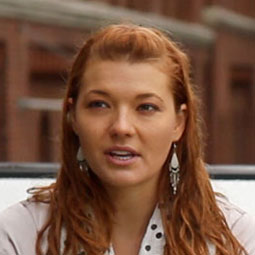
Originally from Northern Virginia, Karja studied urban planning, but is also an avid kayaker and carpenter. Karja's work on Fortnight was detailed on The Huffington Post and praised by the Director of the National Resources Defense Council. Urban planning and architecture icon Andres Duany responded to Karja on Fortnight. Since publishing with the journal, Karja has been hired by Mr. Duany's firm, Duany Plater-Zyberk. She now travels the world creating urban plans for disaster areas. |
4/4




