
FORTNIGHT ISA MULTIMEDIA DOCUMENTARY PROJECT ON THE MILLENNIAL GENERATION: THE LAST GENERATION TO REMEMBER A TIME WITHOUT THE INTERNET. |

contributorsprofile
MARCHING IN PLACE

MARCHING IN PLACE
AN URBAN PLANNER CONSIDERS HUMAN SCALE. KARJA REINVIGORATES THE CRAFT OF VIABLE COMMUNITY DESIGN.
read the essay now >>
AN URBAN PLANNER CONSIDERS HUMAN SCALE. KARJA REINVIGORATES THE CRAFT OF VIABLE COMMUNITY DESIGN.
read the essay now >>

|
On a picturesque street in 19th century Paris, art students are frantically putting the final touches on their work as a bell jangles louder, accompanied by the creaking of wooden wheels. The wheels belong to a cart sent by their professor at the École des Beaux-Arts to collect their work for judging and enforcing the deadline. In French, the word for this little cart is charrette. Two centuries later, a bit past midnight, I am sitting in a small conference room off a bus depot in Montgomery, Alabama, furiously clicking a mouse button. In the room with me are 15 other planners, architects, urban designers, transportation engineers, city officials and more from around the world. We’ve been working since 11 a.m. and will be working until 11 a.m. the next morning. We have come together to donate 24 hours of our time to come up with a plan for a historically blighted neighborhood along the Civil Rights March Route at the edge of downtown Montgomery. We are on charrette—a word which has grown to encompass an entire process but which still, ultimately, means “deadline.” I arrived early in the morning and set about exploring the town in the best way possible: by getting lost. While walking in the already too hot morning, I was approached multiple times by very nice residents who were concerned that I |
was walking and offered me rides, smiling and waving in an incredibly confused manner when I politely declined. Clearly, this is not a town where people walk anymore; despite what may be the most famous and impactful march in our nation’s history having traveled these streets barely half a century ago. Clearly, this is not a town where people walk anymore; despite what may be the most famous and impactful march in our nation's history... Montgomery was formed by two merging European settlements on lands taken from the Creek tribes, and later became the capital of Alabama. In 1861 Montgomery hosted a group of leaders as they founded the Confederate States of America; it was captured by the Union in 1865. In 1886 it led the way for public transportation in the U.S. when it installed the first city-wide electric streetcar system, closely followed by America’s first streetcar suburbs, thereby beginning the depopulation of its city center residential areas. These streetcars, along with over 100 other streetcar systems nationwide, were systematically bought up and torn out by a consortium of auto, tire and oil companies and replaced by roads and privately owned cars. Enter the bus, filling the |

1/7
|
gap left by the streetcar system, and setting the stage for Montgomery’s entry into the national spotlight.replaced by roads and privately owned cars. Enter the bus, filling the gap left by the streetcar system, and setting the stage for Montgomery’s entry into the national spotlight. On Dec. 1, 1955, Rosa Parks refused to give up her bus seat to a white man and was arrested, launching the Montgomery Bus Boycott, led by Martin Luther King, Jr., then the pastor of the Dexter Avenue Baptist Church in Montgomery. Local judge Frank M. Johnson ruled that the bus segregation was illegal, a ruling upheld by the Supreme Court. Ten years later, King led three marches toward Montgomery from Selma, after a protestor at a civil rights rally battling Jim Crow laws was shot there. The first march ended in violence when its 600 marchers were attacked with billy clubs and tear gas by state and local police. The second march attempt was over before it started, due to an injunction issued by Judge Frank Minis Johnson, Jr., but 2500 marchers gathered and marched up to the Edmund Pettus Bridge, halted, prayed and turned back. While no violence occurred during the short-lived march itself, three of the white ministers who marched at |
the head of the group were attacked that evening, and one, James Reeb of Boston, died. A week later, with the injunction lifted, 8000 marchers set out again and this time made it to Montgomery. This third, successful march took five days, and its marchers were accompanied by 2000 U.S. Army soldiers and 1900 Alabama National Guard members as well as FBI agents and Federal Marshalls, all under the direction and support of the federal government. As these marchers crested the final hill along their route, it widened into a broad intersection of three different streets where the old grid of development, aligned to the river, met the newer, compass point-aligned grid. At this transition point they turned, skirting the northwest corner of the Caroline Street Projects, a large mass of government housing shoehorned into two oversized, inhumanly scaled city blocks lining Caroline Street. The marchers began walking downhill towards downtown and the river, their struggle nearly over. But Caroline Street’s struggle, made up of many of the same issues, was just beginning. While housing projects have never been a good idea, few people saw that at first, urbanist Jane Jacobs being one of the few who spoke strongly against them from the outset. |
2/7
|
The Caroline Street Projects, consisting of small, dark institutional buildings with no character, earned this concern from day one. The neighborhood was alwaysone of high crime and bad reputation, despite the buildings at one point being torn down and rebuilt “better.” Though situated very well in the city, atop one of the highest hills overlooking downtown, the community—if it could ever have been called that—while still inhabited, seemed always to be the low point. At around noon, about 20 of us climbed out of a small cavalcade of cars and one large passenger van onto the deserted surface of Caroline Street, and our chatter from the ride over died away. As we stood taking in the debris, graffiti and crumbling housing I noticed a beheaded baby doll—even inanimate playthings couldn’t have a life here. As we got the brief rundown of the site from the planning directors and deputy mayor, a few camera crews began to roll tape of our group—not only were we addressing a historic march route, we were doing a charrette in just 24 hours. As we stood taking in the debris, graffiti and crumbling housing I noticed a beheaded baby doll-even inanimate playthings couldn't have a life here. |
In the two centuries between when the French word for cart first began to take on more meaning for Beaux-Arts students and now, New Urbanists got a hold of the word and applied it to a new method theybegan to develop 30 years ago. This method, now known as a charrette, is different from the normal planning process in many ways, the most notable being the number of stakeholders they include in the process from the start, and the short amount of time in which things are accomplished. In a standard charrette for most any size project, there are a few months of lead-time during which connections are made to ensure the attendance of everyone needed. This is also when the research is done—all of the initial fact-finding, data sets and historic research. New Urbanism is an approach to planning with a very healthy respect for history; also called Neo Traditionalism, its prime output are TND’s, or Traditional Neighborhood Designs. It’s practitioners are attempting to bring back what is best about the way we used to build communities in order to repair our urban landscape and all of the behaviors that are shaped by our built environment. |
3/7
|
At the end of this pressure-cooker of a process, the team will have created a set of plans and the supporting documentation based on things that every attendee who came to a meeting or wandered through the open studio came to the consensuson, and showing components that each of these interested parties can remember having helped shape. Not only does this process result in better plans encompassing more people’s needs, thus cutting down (often cutting completely out) the dreaded rework, it also fast-tracks most plans through the approvals and permitting process because everyone who would need to come into contact with the plan in the future was part of the planning process itself, and therefore any potential objections were already raised and worked through. By bringing everyone together the charrette starts building healthy community before the first shovel is ever hefted. By bringing everyone together the charrette starts building healthy community before the first shovel is ever hefted. In Montgomery, we aimed to do all of that in 24 hours. We were aided immensely by planning director Ken Groves, an incredible man who had long since seen the light and was already transforming his downtown with a new smart |
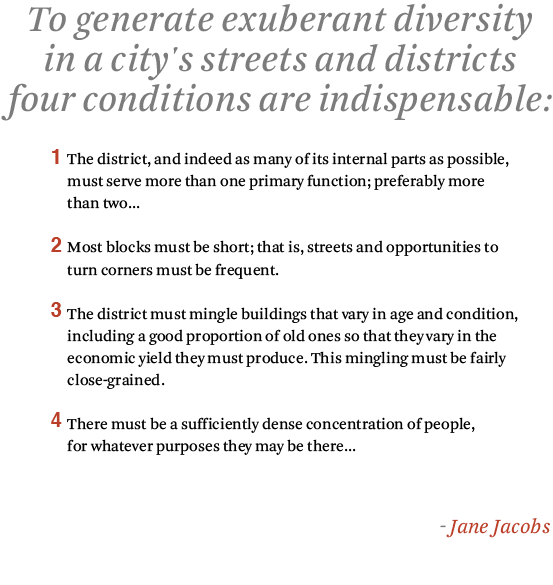
zoning code and a partnership with a great new urban planning firm, Dover Kohl. Our 24 hours of volunteer work was building on the foundations of the successes of that past work, allowing us to accomplish so much in a short period of time. In addition, the city owned the majority of the property we would be addressing, which removed a number of potential roadblocks to the right plan. This previous work also gave us an extra incentive in knowing that whatever we put down on paper would be enacted within the next few years—high-speed for most urban planning work. As the camera news crews continued to roll tape, we began to wander the site, each of us taking different cues from what we saw. A number of stone stairways leading from the street to empty lots spoke of large old houses now gone. The living spaces themselves, when they were intact enough to explore, had small, cramped front doors and entryways leading to narrow hallways and dark spaces lit by tiny windows. The attached dwelling buildings ran back like soldier barracks from the streets, along narrow pathways separated from the buildings from front yards that would be paid a compliment if called postage-stamp sized. The blocks on which these projects were built had an enormous grain, measuring over 900 feet along this blighted block of Caroline, and 450 feet along the shorter sides— |
4/7
|
a standard city block usually ranges from 250 to 350 feet in length and is closer to a square than a rectangle. A football field, for comparison, is 160 by 300 feet. Another interesting find was an alley and a parking lot reaching into the core of the two block area from the perimeter, which would allow us to cut down the size of the blocks by turning them into streets. Having gathered our perceptions and site information, we headed back to the conference room off the bus bay, our world for the next 22 hours. Once back, we split into four groups, each composed of a mixture of different interests. I sat down with a planning department employee, a transportation engineer and a community member from the next neighborhood over from Caroline Street. We took out our markers and started to draw—it could have been kindergarten. The drawing, though, is one of the things that seems to make the charrette model so successful. Speaking is so prone to misperception, miscommunication and ego. When forced to graphically represent your thoughts, consensus just begins to overflow. People begin to see that they all really do want the same things and that, perhaps, they can have them. We moved forward with the clear thought of punching the two alleys through, forming four |
misaligned and much smaller blocks, and at the center of our plan the neighborhood center became clear. We identified this nexus as important and needing slightly different treatment. We quickly rolled through potential different approaches including a plaza ringed by shops, denser housing with shops below facing the central intersection and others. As we approached the end of this stage of work, we began to look outside of the two block area and noticed the larger street grid, and asked each other what would we get if we got rid of Caroline street entirely (which didn’t line up with the two streets terminating onto the two blocks to the south) and instead brought these streets up to meet the other two streets we were creating. Out of this one thought—as is often the case—my group’s plan took shape, with a small square being defined in the middle. We chose to draw rowhouses facing the square, slowly stepping back down to single-family houses at the outsides of the blocks and with heavier apartments and commercial buildings to the northwest corner of the area, with a large plaza for the intersection through which the civil rights march passed. As we approached the end of this stage of work, we began to look outside of the two block area and noticed the larger street grid, and asked each other what would we get if we got rid of Caroline |
5/7
|
street entirely (which didn’t line up with the two streets terminating onto the two blocks to the south) and instead brought these streets up to meet the other two streets we were creating. Out of this one thought—as is often the case—my group’s plan took shape, with a small square being defined in the middle. We chose to draw rowhouses facing the square, slowly stepping back down to single-family houses at the outsides of the blocks and with heavier apartments and commercial buildings to the northwest corner of the area, with a large plaza for the intersection through which the civil rights march passed. As we hurriedly drew in the finishing touches of our concept, other groups began pinning up their work to a series of large foam boards along one wall. As a larger group, we spent the next hour or so reviewing each other’s ideas and discussing implications. Then we ate. Food is another key component of a good charrette, as is coffee. Food still in hand, we began to pull from each of the plans, make choices and synthesize the final approach to repairing Caroline Street. Despite enthusiasm for the idea of getting rid of Caroline Street entirely and reconnecting the street grid of the neighborhood to the south, it was decided that the city would have too much |
more land to gain control of in order to accomplish this, delaying the start of work. Finally, a plan was settled on that celebrated the center intersection, defined more spaces and gave them purposes as parks, walkways and gathering places, and provided a diversity of housing and business types. All that was left was the coloring—another 11 hours of it, and it took every last minute. Post-charrette is a polishing effort, filling in the informational, technical and programmatic gaps needed to complete the plan successfully. The plan is fine tuned, polished and put into action. Often the plan sits for quite a while as bureaucracy takes its turn, but in this case, by next end-of-May I expect to be able to return to Caroline Street and not recognize it, except from the shape of the plan we put down on paper beginning to take shape.  -- This contribution is dedicated to the memory and inspiration of Ken Groves. While I only knew him a brief time, Ken, his passion and his incredible friendliness, had a profound impact on me. It is a rare few in this world who can see straight to the reality of the world and fewer still who are not brought down by it but instead energized to work tirelessly to make it better and encourage others to do the same. Ken was clearly one of those few and sparked a little bit of that ability in every one he came in contact with. Gregarious and gracious is how I will remember Ken, fire and spit and fervor for the world and its future. |
6/7
| Originally from Northern Virginia, Karja studied urban planning, but is also an avid kayaker and carpenter. Karja's work on Fortnight was detailed on The Huffington Post and praised by the Director of the National Resources Defense Council. Urban planning and architecture icon Andres Duany responded to Karja on Fortnight. Since publishing with the journal, Karja has been hired by Mr. Duany's firm, Duany Plater-Zyberk. She now travels the world creating urban plans for disaster areas. |
7/7