




FORTNIGHT ISA MULTIMEDIA DOCUMENTARY PROJECT ON THE MILLENNIAL GENERATION: THE LAST GENERATION TO REMEMBER A TIME WITHOUT THE INTERNET. |

contributorsprofile
TWO TRADITIONS
TWO TRADITIONS
HONEST VALUES CREATE LASTING FORMS.
TIMOTHY COMPARES AMISH TO DANISH
FURNITURE DESIGN.
Read the essay now >>
HONEST VALUES CREATE LASTING FORMS.
TIMOTHY COMPARES AMISH TO DANISH
FURNITURE DESIGN.
Read the essay now >>


|
As a furniture designer involved in the production of hardwood pieces, I've developed a unique understanding of two communities well known for their furniture design and construction traditions. But I had to first overcome a few of my own stereotypes about the Amish People and Pennsylvanian Dutch culture to uncover this knowledge. As a young designer I was convinced that the Danish Modern era, with its simplicity and geometric forms, was the pinnacle of design. If you had asked me then, something like traditional American Amish furniture was just something I was not interested in—it was boring, unsexy and lacked sophistication. As a designer, I have always found myself drawn to the simplest forms and austere beauty. This is one reason why I became enamored with Scandinavian design when I was in college. I was drawn to its sophisticated simplicity. It seemed like America had nothing similar, but rather a corporate culture that pushed product design “of the moment.” Furniture designers were embracing fads that came and went every few months. Products were made of the absolute cheapest materials to be thrown away within a few months. Whereas the Danish Modern movement—which has defined the Scandinavian style of fashion and products for over fifty years—offered pieces meant to last. Intended to be kept in the family for generations, these objects were made using the |
very best techniques and materials available. As a designer, I have always found myself drawn to the simplest forms As I discovered upon working with the furniture shop Shimna, America does actually have its own tradition that slowly tweaked designs to produce considered objects, built to last: Pennsylvanian Dutch design of the Amish Community.and austere beauty. In working closely with both Danish and Amish woodworkers, I found that both communities share a certain dark sense of humor. I think this is because both furniture-making traditions developed out of adversity. The Amish originated in Germany and Switzerland, becoming immigrants to America in the late 19th century because they fled religious persecution. The Danish Modern movement developed directly after the Nazi occupation of Denmark. And from my perspective, this event still affects the Danish people and influenced the development of their philosophy of industry. I studied in Denmark at the Danmarks Designskole, culminating in an intensive workshop where we had three months to build a chair. That sounds simple enough, but the Danes taught me that a |
1/3
|
chair is actually the hardest piece of furniture to design. It must support a living person for hours at a time. The hardest part of making furniture is making it comfortable. Making the form look interesting is the easy part, but designing something that a fickle human body finds comfortable is the real challenge. It was surprisingly comfortable, displacing the weight of my back across the slightly curved, slightly splayed turned spindles Flash forward a couple of years. I find myself inspecting an Amish-made Windsor chair. This is a traditional American design that we all have seen, maybe in a grandparent's kitchen or in a Whistler painting. These chairs scream turn-of-the-century Americana. Seeing this—and having beaten my head against the wall at the workshop in Denmark while working on my chair—I tried to look past my initial thought of, "Ugh. Grandma chair." I sat in it… and it was surprisingly comfortable, displacing the weight of my back across the slightly curved, slightly splayed turned spindles that made up the back. The bent wood supported every part of the body nicely. The more I considered the chair, the more I liked it. Now, this same chair (in some interesting colors that help you to see the chair with fresh eyes) is now in the Shimna collection.that made up the back. |
Both Danish and Amish furniture reject most ornamentation, favoring basic functional shapes and using mainly wood. Where they start to diverge, however, is that Danish Modern furniture design totally embraces technological advances of the postwar era. These designers use aluminum and bent steel tubing for chair frames. They also have an absolute obsession with bending and molding plywood. Science, technology and design reach a harmony in the Danish furniture industry. Designs developed to meet the needs The Amish, of course, reject technology outright. The fear of technological advances during the industrial revolution is what drove these people from Germany to Pennsylvania in the first place. They wanted to recreated Olde Germany in the hills and valleys of PA, which reminded them very much of the homeland. Today, they use the same methods, tools and techniques developed centuries ago. Much of Amish furniture (and life) remains frozen in time. The Amish furniture makers have developed their designs over time through community. A few simple shapes have become predominant, evolving over the past couple hundred years almost via collective consciousness. Designs developed to meet the needs of theof the community, through techniques passed down by apprenticeship. |
2/3
|
community, through techniques passed down by apprenticeship and father-to-son time at the woodworking workshop. For example, one Pennsylvanian woodworker with whom I have a working relationship calls his brother and his eldest son for help with projects when he has too much work. At the start, his son would sweep the floors, then move into sanding. Over time he’ll be given more and more opportunities to develop skills from his father. There's a lazy old dog in the shop, Behind our workshop is a barn with two horses and two carriages used for transportation. The stove is wood burning, so there's a huge woodpile out back. On a nearby hill, there are beehives, so bees are everywhere (although our carpenters pay them about as much mind as a fly, not freaking out like someone in New York City would). There's a lazy old dog in the shop, covered in sawdust.covered in sawdust. This is much different from the spotless, lab-like workshops that high-end furniture makers like Fritz Hansen use in Denmark. An important point is that Danish Modern design focuses on the individual, unlike the focus on community in the Amish tradition. Many of the founders of Danish |
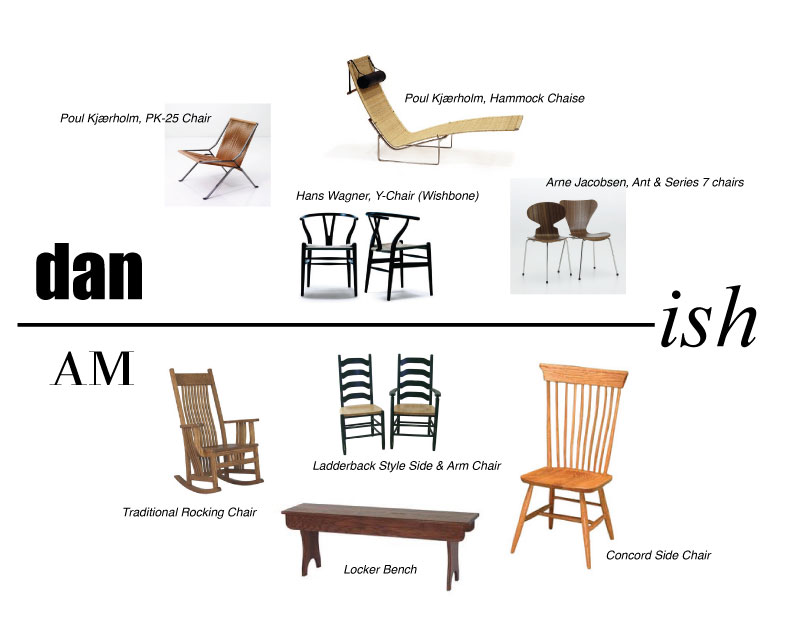
Modernism (Poul Kjærholm, Hans Wagner, Arne Jacobsen) became international design stars, professors and gurus. I went on a study tour throughout Denmark and saw some amazing engineering facilities. I saw workers in their clean, crisp workmen jumpsuits and the same blue color in every factory. It was a stark contrast to the workshops in Pennsylvania I work with now. There is not the same amount of personable interaction in Denmark. Mostly my interactions in Pennsylvania are straightforward, and the transactions honest. In Denmark, working communication comes with lots of subtext, and if you don’t pick up on these subtleties you will have no idea that the guys are joking with you. After working with the community in Pennsylvania, and gaining experiences as a designer, I now celebrate both the Danish and Amish furniture traditions as being my biggest influences. Both have had an immense impact on current trends in my industry. One originated in the 19th century, the other in the 20th century. But both grew from utopian ideals to create an appealingly truthful approach to materials.  Author’s note: I have simplified for the sake of argument the term ‘Amish’ to encompass all of the Pennsylvanian Dutch furniture makers, some of whom are Mennonite, a very similar tradition (albeit minus the beards). |
3/3




