





FORTNIGHT ISA MULTIMEDIA DOCUMENTARY PROJECT ON THE MILLENNIAL GENERATION: THE LAST GENERATION TO REMEMBER A TIME WITHOUT THE INTERNET. |

contributorsprofile
the moroccan carpet

the moroccan carpet
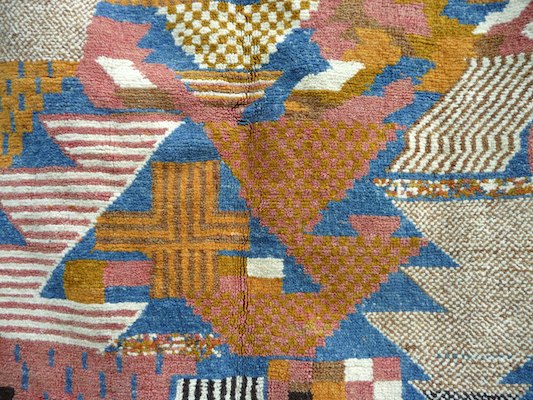
SOME RUGS GET TO HAVE ALL THE FUN. ALIA EXPLAINS WHY THE MOROCCAN CARPET ISN'T ONE OF THEM.
read essay now >>
SOME RUGS GET TO HAVE ALL THE FUN. ALIA EXPLAINS WHY THE MOROCCAN CARPET ISN'T ONE OF THEM.
read essay now >>


|
Over the last century carpet weaving in Morocco has transitioned from individual production among families and tribes to an income-generating activity for rural Amazigh women . The once traditional craft has shifted into a larger marketplace, that of global trade. Today, carpet weaving in Morocco is not only a tradition, but has also become a commodity for tourists, wealthy consumers and foreign collectors. Furthermore, it must compete for attention with the already well established oriental carpet market from historically better known carpet-producing nations. These oriental carpets gained renown very early. They were first introduced to Europe during the Crusades, most notably during the Fourth Crusade that followed the invasion of Constantinople in 1204. After ransacking the city, the conquering Venetian armies proceeded to loot, burn, and steal the city’s most precious items. According to Geoffrey de Villehardouin, a historian and knight who fought in the Fourth Crusade, never had so much loot been won in any city in the world. He wrote that the treasure gained was “so great that none could tell you the end of it: gold and silver, and vessels and precious stones, and samite, and cloth of silk, and robes vair and grey, and ermine, and every choicest thing found upon the earth.” 2 |
Although not mentioned by name in de Villehardouin’s list of valuables, it was clear that early Anatolian carpets were among the goods that made their way back to Venice and the rest of Europe amidst the conquerors’ chest of war spoils. While 13th century wars and conquests opened borders, it was the international treaties following the Crusades that legitimized early trade between the East and West. One such treaty was the Pax Mongolica, which allowed Venetian traders to travel safely as far as China or India; this in turn laid the foundation for the development of the Silk Road and the rapid growth of the Oriental rug trade. From the beginning, Oriental carpets were analogous to wealth and status; indeed, the first carpets to travel the Silk Road were valued so highly that they were used as currency rather than sold as commodities. By the 14th century,these carpets were no longer used as currency but had acquired their own value—a value that was so high that only Europe’s most elite could afford to buy them. Once the initial process of acquisition, trade, and appraisal had begun, Oriental carpets began to rapidly flood the market. Over the course of a century, their dominance became so complete that carpets from other regions never had a chance for competition. |
1/7
|
Among these were the Moroccan rugs that never infiltrated the European market to the same extent, despite their rich textures, distinct designs, and master artistry. The overall popularity of Moroccan weaving styles continues to be stymied by the fact that Moroccan rugs represent a departure from the Oriental norm. The consequences of this have reverberated throughout history, so that in the modern day rug-collecting world, Moroccan rugs are still deemed second rate. Because of Morocco’s delayed debut on the global carpet scene, current production is at a marked disadvantage. Despite their rich weaving tradition, Moroccan artisans do not have the centuries of history that cement their rugs in Western imaginations as luxury goods, nor is there sufficient money and scholarship to support current production.In the last few years, ‘Morocco’ as a brand has begun to trend within select fashion circles and interior design communities; as a result, very select styles of Moroccan rugs, like the Boucherites or Beni Ouarains, have reached the spotlight. However, on the whole, dealers, collectors, and casual consumers continue to undermine and undervalue the Moroccan carpet. |
Since Moroccan weavers are just as skilled and knowledgeable as their Turkish and Persian counterparts, the real question remains why Moroccan carpets are still measured against the Oriental standard. Undoubtedly, Moroccan weaving styles vary from early Oriental styles. I believe, however, that this only adds to the allure of the carpet-- embedded in its warps and wefts is the story of Morocco’s unique cultural heritage and the identity of its Amazigh people. Unfortunately, though, my opinion is in the minority. The overall popularity of Moroccan weaving styles continues to be stymied by the fact that Moroccan rugs represent a departure from the Oriental norm. Understanding the geography of the region offers insight into Morocco’s historically peripheral role in the global carpet trade. Yet, while geography is important to consider, it does not explain why Morocco continues to be marginalized. Instead, I argue that what ultimately precluded Moroccan rugs from the global carpet trade was a long history of Renaissance era traders, 18th century dealers, and contemporary rug collectors who created an impenetrable carpet market based on antiquated notions of luxury, prestige, and power. |
2/7
|
Part 1: A Stilted Start: Morocco’s Geographic Relation to the Rest of the “Orient.” Historically there have been many theories as to why Moroccan rugs neither rose to fame nor brought forth the same amount of fortune as did Oriental carpets. Scholars in the 18th century believed that Moroccan rugs were merely derivative of their Oriental cousins, implying that these Moroccan rugs never existed prior to the birth of the Oriental carpet trade. Even though countless tomes have been written about the history, styles, and meaning behind the oriental carpets, there are only a handful of authoritative English-language texts about the Moroccan carpet. Most of these books begin in the same way—with an apologetic description of the Moroccan carpet, which is described as an errant offshoot of the esteemed Oriental carpet. Bruno Barbetti, author of the book 'Berber Carpets of Morocco' began his book on the symbols and origins of meaning in Moroccan carpets with this parable: The Berber Carpet is unique. It is related to the carpets of Islamic peoples of the Orient, so much is certain. But within that relationship the Berber carpet resembles an illegitimate child, |
scraping a living far away from its family, with no share in the wealth of its home, and apparently retarded in its development. The special character of the Berber carpet can be explained geographically and historically. It is mainly due to Morocco’s remote situation on the Mediterranean, far away from the Orient. 3
While this reductive analysis of the relationship between carpets in Morocco and carpets in the Middle East provides a simple answer as to why Moroccan rugs have lagged far behind in their popularity, it only explains part of the story. This theory and many more before it all give the impression that Moroccan carpets descended from Oriental carpets, implying that Moroccan rugs are a lesser permutation of Oriental carpets. On the contrary, evidence has since been found proving that Moroccan carpets have existed in Amazigh North Africa for thousands of years, and Moroccan artisans have been weaving just as long as their counterparts in the Middle East and Central Asia.
Furthermore, Moroccan art and culture is not solely derivative of the Oriental model, but instead draws its inspirations from a mélange of outsider influences. In addition to the Islamic Middle East, Morocco also owes its unique style to its 200-year reign over Moorish Spain and to its position in the northernmost edge of the African diaspora. |
3/7
|
Even though Morocco was not engaged in the Silk Road, its lands were dotted nonetheless with caravan routes that made their way down the coast to West Africa, and through the Sahara desert. For centuries Morocco was an influential hub that shuttled goods and people across the North and down through West Africa. Although Morocco’s inter-African trade activity kept it far away from the power hubs of Renaissance Italy, it did allow Morocco to develop its own sophisticated aesthetic, which drew on elements from many different cultures.
In addition to this, Moroccan cultural expression was further differentiated by its strong indigenous Amazigh presence. In the late medieval period, when the Persian and Turkish empires were setting the standard for Islamic art and culture, Morocco’s Amazigh dynasties were forging their own sphere of influence in the west based upon their conquest of the Iberian Peninsula.
While most Arab countries expressed their cultural identity as an extension of the Oriental model, Morocco owed its artistic and political leanings to its indigenous population, as well as to its position at the nexus of the African, Iberian, and Middle Eastern worlds.
In Arabic, Morocco is called al maghrib al aqsa, which literally means ‘the West’— a nomenclature |
that positions Morocco at the furthest reach of the Islamic empire. Indeed, it is located in the far northwestern tip of the African continent, a mere nine miles south of Europe through the Strait of Gibraltar. Thus, as Morocco is defined by its remoteness from the Orient, its rugs are explained vis-à-vis their distance from the classical oriental carpets. Given Morocco's location far from the nexus of activity, Moroccan goods and textiles were largely absent from the Oriental Rug craze that swept through Europe during the Renaissance period Ultimately, it was not only Morocco’s cultural and political autonomy but also its physical distance from the Orient that allowed for such a differentiation among its textile arts. Since Moroccan textiles existed independent geographically and stylistically of the oriental classical carpets, it follows that Moroccan textile arts never benefitted from the acclaim and renown of the oriental carpet.
Scholars argue that during medieval times, trade flourished along the routes established by the Crusades such as the Silk Road. Given Morocco’s location far from the nexus of activity, Moroccan goods and textiles were largely absent from the oriental rug craze that swept through Europe |
4/7
|
during the Renaissance period. Nevertheless, as globalization has leveled the playing field, it is clear that Morocco’s relatively late arrival in the global carpet trade has impaired its chances of future success. While geography explains part of the story behind the proliferation of oriental carpets, the other part of the story is about the individuals who brought these carpets into the spotlight in the first place, and how these individuals cultivated the carpet trade over time. Part 2: Carpet Collectors and Dealers as Tastemakers When it comes to the global carpet trade, there have been two significant periods in history. The first period occurred prior to the 19th century and introduced classic Oriental carpets to the Western world. The second phase began at the turn of the 20th century and not only introduced these carpets to the New World but also expanded the field of oriental carpets to include lesser-known tribal carpets from the Middle East and Central Asia. The first phase in the global rug trade was not a momentous occasion that happened overnight. Instead, it was marked by a slow and steady growth in the industry that coincided with European military advances into the Middle East and Asia. The Crusades marked the beginning of |
this era; with the establishment of the Silk Road in the 14th century, the exchange of goods and people between the East and the West was quickly formalized. It was during this time that carpets first made their way into Europe. Over the course of the next several centuries the global rug trade would only gain in momentum.
So great was the connection between art and carpets, most styles of carpets were named after the painters who depicted them rather than by their place of provenance. These early Oriental carpets emanated from Anatolia (modern-day Turkey), but beyond this distinction little else is known.
|
5/7
|
Instead, these carpets came to be referred to as Holbeins, Memlings, Crivellis, Lottos and Ghirlandaios, after the Italian and Dutch painters who produced them. This system of classification is still in place as both modern carpet scholarship and rural weavers refer to the carpets by the names of these European painters.
Although these European labels for oriental carpets have long been accepted in the academy of carpet weaving, it nevertheless makes one wonder at a system that repackaged the original handwoven product, divested it of any Eastern identity, and rebranded it based on terms of Western power and prestige.
One example of this rebranding of oriental carpets was in the 1400s when Anatolian carpets began to appear as objects of decor in European religious paintings.
 |
These Islamic carpets would oddly set the scene for Christian annunciation scenes. Within time these carpets began to disappear from Christian religious paintings, but their artistic appeal lived on in the minds of the European nobility. By the late 15th century, these carpets began to take on a more central role in paintings, no longer appearing on the floor or as a backdrop, but rather acting as a dominant object in Renaissance portraiture paintings.
These highbrow portraits are living evidence of the confluence between European nobility and their chosen décor of oriental carpets. As these paintings became more popular and the carpets were more ubiquitous in society, the carpet fervor spread to the masses. This alone was enough to turn Oriental carpets into coveted status symbols for the masses.
From the late 16th century onwards, “possession and display of oriental carpets became a way for upwardly mobile bankers, merchants and the like to advertise their arrival at positions of social status.” 4 It was a trend popular with the emerging middle class seeking to gain prestige. As a result of their exposure in the art world and due to relative scarcity and wealthy patronage, over the course of the Renaissance period, these carpets became prized possessions for all Europeans. In |
6/7
this way, war, then commerce, then art paved the way in determining the potential for growth for these types of oriental products and established a system for wealthy Europeans to control the market.
***
Alia Kate is the founder of Kantara, founded 2008, a fair trade rug importing business that sources hand woven rugs directly from women artisans in rural areas of Morocco. She graduated from Oberlin College and worked in Morocco for a private consulting firm. She currently lives and works from Brooklyn, NY. *** |
1. In this piece I will use the word Amazigh and Berber interchangeably to refer to the ethnic indeginous population of Morocco. These people were first referred to as Berber by those who settled in the coastal outposts during the Roman Empire’s invasion of Morocco. Over the centuries that name has stuck, however there is some speculation that the etymological identity of this word was derived from a word that means “barbarian” in English. While there is no conclusive evidence either way, a shift in thinking has begun, starting in Academia and reverberating out into popular culture. Morocco’s indigenous population has begun to distance themselves from their previous distinction as Berber. While some Moroccans still call themselves Berbers, in the last decade most have begun to refer to themselves as Amazigh (or the plural form: Imazighen), literally meaning “free people.” 2. Villehardouin, Geoffrey de: “Chronicle of the Fourth Crusade and the Conquest of Constantinople (London: J.M. Dent, 1908), 65. 3. Barbatti, Bruno. Berber Carpets of Morocco: The Symbols Origin and Meaning, ACR Edition Internationale, Paris: 2008. 4. Verde, Tom. “Threads on Canvas,” Saudi Aramco World, January/February 2010. |
7/7




