




FORTNIGHT ISA MULTIMEDIA DOCUMENTARY PROJECT ON THE MILLENNIAL GENERATION: THE LAST GENERATION TO REMEMBER A TIME WITHOUT THE INTERNET. |

contributorsprofile
RECKONINGS

RECKONINGS
FINANCIAL CRISIS REVIVED MORAL WORDS.
TIAGO, ECONOMIC HISTORIAN, TRACES
HOW WE REPORTED IT.
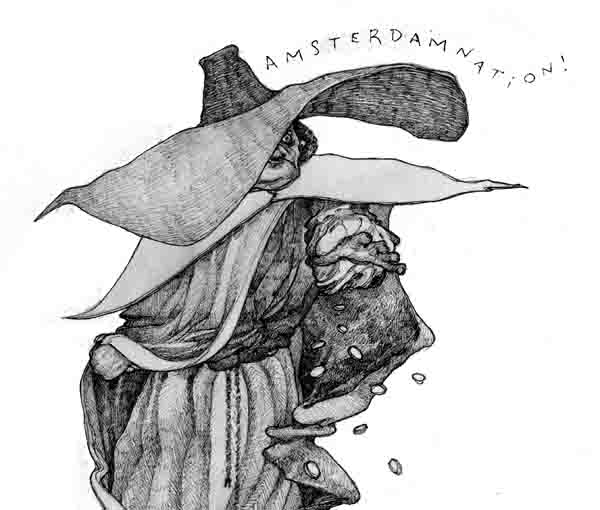
Read the essay now >>
FINANCIAL CRISIS REVIVED MORAL WORDS.
TIAGO, ECONOMIC HISTORIAN, TRACES
HOW WE REPORTED IT.
Read the essay now >>


|
The reckoning is an ideal. It stands for a mythical moment where morality and justice are reconciled with bookkeeping. It imagines us able to both keep record on, and understand the world around us. The reckoning is a marker of revelation, when what was hidden comes into full view. In August of 2008, the world seemed to be unraveling. In August of 2008, I traded the United States for the Netherlands, taking my first faculty appointment at the School of Economics of the University of Amsterdam. Oblivious, I had my head down writing lecture notes and searching newspaper ads for a place to live. While my life was in a state joyous anticipation, the rest of the world seemed to be unraveling.The financial system was on the brink of collapse. The chronology of events that lead to the current crisis is well established. The first signs of alarm came in early 2007, when several subprime loans reset into higher interest payments. Borrowers unable to pay due had their mortgages foreclosed, while lending agencies filed for bankruptcy. In March 2008, as foreclosures mounted, the investment bank Bear Stearns asked for emergency assistance from the Federal Reserve. Bear Stearns |
was eventually sold to JP Morgan Chase at a bargain price on May 30th. A misleading calm followed. The summer brought a different sort of controversy and entertainment: the Party conventions, rising oil prices and debates about drilling, Michael Phelps’ and Usain Bolt’s Olympics. Then came September. On the 7th, the US Treasury took over Fannie Mae and Freddie Mac. Two days later, Lehman Brothers was the target of everyone’s attention as its stock value plummeted. Failing to find new lines of credit or a buyer, the 150-year-old investment bank went bankrupt. On September 14th, the world’s largest insurance company, AIG, asked for Federal Reserve assistance, which was initially denied. The Dow Jones Index promptly dropped over 500 points. Worse still, the credit markets froze. Banks refused to lend to other banks, and money funds to companies, each fearing for the solvency of the other. AIG eventually got its Federal Reserve loan, and Treasury Secretary Hank Paulson announced a system wide rescue plan on September 19th, the number: $700 billion. With great drama and some embarrassment, the rescue plan failed a first vote in Congress on September 28. The stock market registered a record drop of over 700 points. More banks had to be saved from themselves— |
1/6
|
prominently Washington Mutual and Wachovia. A redrafted plan was signed into law on the third of October. But the world equity markets continued to slide, and until the first week of October was the worst on record for the Dow Jones index. By mid-October, central banks, led by the Federal Reserve, made emergency injections of liquidity with rate cuts to restart the credit markets and stave off the equity drop.
Oxford English Dictionary:
1. the action or process of calculating or estimating something; a person's opinion or judgement.reckoning noun 'mass noun' 2. the avenging or punishing of past mistakes or misdeeds: the fear of being brought to reckoning | 'count noun' there will be a terrible reckoning. 3. (the reckoning) contention for a place in a team or among the winners of a contest. At the Faculty of Economics in Amsterdam, students were immediately interested. They organized the professors to speak of the crisis. A mock living room was mounted in the atrium of the main building. Once a cold, featureless space of metal and stone, the atrium soon gained two couches and a flat screen TV blaring financial news 24/7, the latter of which made |
an appropriate atmosphere for that kitsch classic Bruno Amadio painting, The Crying Boy. Over the weeks to come, professors would sit with journalists, who then sat with bankers to discuss the challenges facing world finance. I walked past this sight, grabbing a sandwich in the cafeteria and going back to my office to work on my teaching. Then, in mid-October 2008, my head finally lifted. The immediacy of crisis had passed, but its legacy would clearly not go away. Barack Obama could have changed history had not subprime beat him to it. We had entered a new era, and it was a pessimistic one. To signal the finitude and damn of an uncertain economy, the New York Times began a series to make sense of the dramatic events of the weeks before, and it called it “The Reckoning.” (link here). The tone of the series was sober and detached; too much so given its unifying title. The first article was by Gretchen Morgenson, who had been cautioning about the subprime crisis since the summer of 2007. Instead of repeating the story of the housing bubble, she focused on how the financial system had been tied together by dubious inventions, stating that “the system was vulnerable because of intricate financial contracts known as credit derivatives, which insure debt holders against default.” |
2/6
|
The explanation for the crisis was charged on the nameless executives that relied on those contracts to make “cash.” The “Reckoning” series, after some scene-setting articles, began writing down names in a list of responsible agents of crisis. On October 3rd the Securities and Exchange Commission headed by Christopher Cox was portrayed as negligent in examining the mortgage investments of banks. The building industry was indicted as lobbying for loose regulations in construction and lending, as early as the Clinton presidency. Wall Street’s irresponsibility was showcased in an article about Citigroup. And, in early December, the feature targeted Moody’s Investors Services and Standard & Poor’s, the rating agents that were hostage to conflicts of interest and fostered a false climate of trust and confidence. One of the characters most vilified in the fall months of 2008 was the retired Federal Reserve Chairman, Alan Greenspan. When he stepped down in 2006, the business press was unanimous in portraying him as the most successful chairman in history. Greenspan was offered a multi-million dollar book deal for his biography. As his biography was in press and the book tour being prepared, Greenspan was caught. Peter S. Goodman had a “Hard New Look at the Greenspan Legacy” for the New York Times. The |
article quoted Greenspan in 1994 reassuring that “risks in financial markets, including derivatives markets, are being regulated by private parties.” Criticism of Greenspan grew to a flood of print when, in one of the most remarkable events of this period Greenspan testified before Congress. The video, the audio and the transcript of Greenspan’s words echoed on all news media: “I made a mistake in presuming that the self-interests of organizations, specifically banks and others, were such as that they were best capable of protecting their own shareholders and their equity in the firms.” Widespread public indignation towards policymakers’negligence and hypocrisy was best expressed by writer Gretchen Morgenson. “I'd like to give my hypocrisy meter a breather.” In the traumatic months of September and October, the dominant frame in the generalist press was to demand accountability. If the end of days was upon us, then the man to carry the burden of blame was Alan Greenspan.
Wikipedia:
The Reckoning (disambiguation) Multiple entries: Seven on Literature, six on Music, three on Television, two on Films, two on Gaming. |
3/6
|
The articles that made up “The Reckoning” did not speak with anger or with calls for punishment. It offered a chill accountancy of greed, and corruption, but also and less damningly, found plenty of fear and panic and stupidity. As Joe Nocera reports about that crucial week in mid-September: “It was fear, not greed, that was driving everyone’s actions.” Despite my initial expectations, informed by Roman Catholic visions of doomsday, the reckoning is not a vengeful trope. We have grown familiar with the idea of reckoning; The New York Times had used it dramatically before, to describe the world post-September 11 (link here). Highlighting a global disparity of wealth, many financial writers in the last decades have remarked that the wealth of the rich is undeserved and unsustainable. Some examples are James Dale Robinson and William Rhees-Mogg's 2004 The Great Reckoning, William Bonner and Addison Wiggin's Financial Reckoning Day of 2004, and Charles H. Coppes 2007 America's Financial Reckoning Day. But “The Reckoning” shows up for work everywhere in our cultures. It is songs, films, TV series, spy and Christian novels, with no relation to finance or the world of money. |
Encyclopaedia Britannica:
Dead Reckoning Determination without the aid of celestial navigation of the position of a ship or aircraft from the record of the courses sailed or flown, the distance made (which can be estimated from velocity), the known starting point, and the known or estimated drift. It was knowledge, and not retribution that most of us needed in the fall of 2008. The characters of the great financial story of our century were unknown to all but the specialist reporter and the Wall Street insider. Among the public, only a very few could hold to memory the increasing torrent of jargon: subprime, derivatives, short selling, CDO, CDS, NINJA. As Joe Nocera of the New York Times wrote on October 2nd, 2008: “It’s not like a stock market crisis, where the scary plunge of stocks is obvious to all. The credit crisis has played out in places most people can’t see.” Just as formidable as the events that overnight froze the global flow of credit was our lack of comprehension of them. It was naïve to expect any pundit could make sense of the deeds and misdeeds that led us to it, just weeks after the credit crash. That accountancy could only have been a rough approximation. |
4/6
|
“The Reckoning” signaled no final moment. Instead, the crisis evolved, changing from a private credit crisis to a sovereign debt crisis to an industrial and commercial contraction. Alongside it, interpretations of events and promised panaceas have multiplied. Nick Paumgarten’s writing in the New Yorker (May 18, 2009) conveys the reporter's frustration in taking in all angles of the story. He offers a dizzying list that should not be read in a single breath: This crisis is the culmination of events and trends reaching back, depending on your perspective, four, seven, seventeen, twenty-two, twenty-seven, thirty- eight, sixty-five, or a hundred and two years. (...) The causes are technological, mathematical, cultural, demographic, financial, economic, behavioral, legal, and political. Among the dozens of contributors and culprits, real or perceived, are the personal computer, the abandonment of the gold standard, the abandonment of Glass-Steagall, the end of fixed commissions, the rating agencies, mortgage-backed securities, securitization in general, credit derivatives, credit-default swaps, Wall Street partnerships going public, the League of Nations, Bretton Woods, Basel II, CNBC, the S.E.C., disintermediation, overcompensation, Barney Frank and Chris Dodd, Phil Gramm and Jim Leach, Alan Greenspan, black swans, red tape, deregulation, outdated regulation, lax enforcement, government pressure to lower lending standards, predatory lending, mark-to-market accounting, hedge funds, private-equity firms, modern finance theory, risk models, “quants,” corporate boards, the baby boomers, flat-screen televisions, and an indulgent, undereducated populace. |
Far from bringing us clarity and closure, “The Reckoning” was a starting fumble into the complex world of finance—its practices, its values, its place in our economies and polities. Our democracies, our discourse, our imagination are now being displaced as much as our economies.
Dutch to English Dictionary:
rekening de ~ (v) account (the ~), invoice (ww.), bill (ww.), bank account (the ~) In 2009, I took a couple of night courses in Dutch. Not that I much need it: From the baker to the taxi driver, the Dutch speak a clear and confident English. I learned the rudiments of table politeness and tourist curiosity. When I was done with my dining and drinking and ready to leave, I learned to say: De rekening, alstublieft… (the bill, please). It took two years, but the ripples of Wall Street’s splash had finally arrived at the canals of Amsterdam. So I closed my accounts and was on the move again. |
5/6
|
*** Tiago Mata is an intellectual historian from Portugal who specializes in economics and its portrayal in historical news media. He is currently a Research Associate at the Department of History and Philosophy of Science at the University of Cambridge, after a stint as Research Fellow at the Center for the History of Political Economy at Duke University. He has a PhD in Economic History from the London School of Economics, and an MPhil in Development Economics and Methodology from the University of Cambridge.His previous pieces for Fortnight are On Narratives, Killing Digital Curation and Caricatures. |
6/6




