
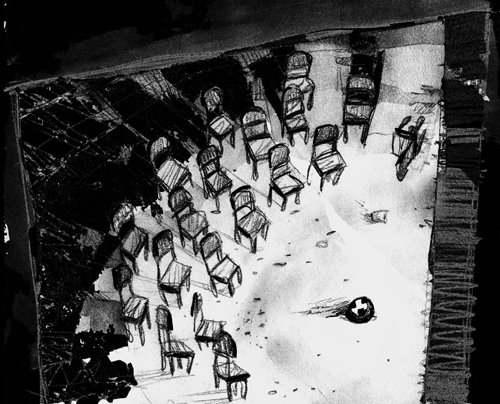
Illustration by Matt McCann
I
From my flat in Ramallah’s Old City, I look down onto a large parking lot. Though surrounded by houses and shops, it is normally empty. During the evenings, local kids play football here, sometimes late into the night.One month ago, a bachelor party was held in the parking lot. It was a Thursday evening–the beginning of our weekend–and a young man was celebrating his upcoming wedding with around forty friends.
The partygoers had built a dance floor out of wooden boards and painted it black. At one end of the dance floor was a DJ booth and three heavy looking loudspeakers. At the other end were fifty white plastic chairs, which the guests had probably brought from home. The chairs were neatly arranged, waiting to welcome any passerby who might want to join the party. The dance floor was lit up using halogen lights. These were placed on tall stands, giving the appearance that a show was about to take place.
I arrived home late from work. I had been writing about the Israeli army’s use of Palestinian children as human shields. My report that day was on two Israeli soldiers who had been prosecuted in the wake of Israel’s 2008-2009 offensive in Gaza. The soldiers had forced a nine year-old child at gun point to open a suitcase they thought contained explosives. That morning, my colleagues and I had learnt that the soldiers had been charged with "overstepping authority" and "unbecoming behavior." This was a good sign that they would get away with a light sentence.
It was 9 p.m. when I entered my apartment building. Everything was more or less in place for the bachelor’s celebration. A few people were doing sound checks in the lot below. Twenty minutes later, the party was in full swing.
I could hear the festivities clearly from my living room. The DJ was playing Fares Karam’s recent hit, El Ghorba. I decided to have a drink by my window and watch.
All the partygoers were on the dance floor. Some people were dancing Dabke. Others were just hugging each other and jumping around. A few passersby had joined the party and were being offered tea and nuts. The kids who normally play football were leaning against the speakers, or wrestling nearby, or throwing stones at each other.
I could hear the MC as clearly as if he were talking into my ear. Not long after I started watching, and following the arrival of a number of polished, black, four-wheel drive cars, I heard the MC welcome everyone to the party, and extend his warmest greetings to everyone who had just arrived from Fatah. The MC repeated this welcome twice in the course of the evening.
II
The whole neighborhood is enjoying the party. A couple of families have fetched their own chairs and are watching from outside their front doors. Those who live further away lean out their balconies and watch from afar.
The nearby shops are open. Salam is smoking between the sides of the lamb that hang outside his butcher’s. He is with his cousin Hany, who is from East Jerusalem. I met Hany a few days ago. He told me that he and his family are preparing to move into Salam’s flat in Ramallah. This is because the Israeli police will soon evict him from his home in Jerusalem.
A few doors down, Salam’s uncle is standing outside his kebab shop, nodding to the music. I want to go to his restaurant, but I can see one of his employees eating. I will wait. If I go now, Salam’s uncle won’t let me pay for my meal. He will say,
"We were already eating when you arrived. I cannot accept your money. You dined with us."
The owner of the new, upmarket sweet and nut shop is sitting outside, fiddling with his prayer beads. I passed him earlier in the evening. As usual, he raised his hand with considerable difficulty (he has Parkinson’s disease) to greet me, and welcome me warmly into his shop.
Ahmad the grocer is the only one inside. He is closing up. Business is going badly for him. Last month, his wife converted their bedroom into a photography studio to make up for lost profits. Tourists and foreign workers like me go there to be photographed in elaborate Bedouin clothes. They send the photographs home to their families who are curious about what life is like in Palestine.
The family who often sit outside the Ramallah municipality administrative offices have arranged their chairs in a circle just below my window, and their shesha is bubbling away in the middle. I have never spoken to them, but I often see them outside one of the expensive French cafés near Jaffa Street. I think it is called Café de la Paix. Half of the family are albino and everyone in the neighborhood whispers incest. I have suggested that there are many other explanations for why someone might be albino, but people here have already made up their minds.
On a balcony to my left, there are two beautiful girls singing with the music. They look like they want to dance with the boys down below. They won’t, in case anyone sees them. My landlord and I passed one of them last week outside the ice cream shop on Rukab Street. I remember this because my landlord turned to me and said,
"I know they wear hijabs. But trust me, these girls are up for it with foreigners like you."
III
I had been watching the party for two hours when the first scuffle started. For no apparent reason, one person pushed another in the middle of the dance floor. In a flash, the first guy had his collar grabbed and was having his head forced downwards towards the ground. After a few seconds, the other partygoers ripped the two apart and everyone went back to dancing.
Twenty minutes later, the same two clashed more seriously. I missed how the fight started, but I saw one of them swing impressively and punch the other squarely in the face. My neighbors rushed forwards to get a better view.
If one of the fighters had pulled out a knife or a gun, everyone’s movements on the dance floor would have been different. One set of people would have pushed away from the center, trying to flee, and another smaller group would have pushed inwards, either to stop their friends from doing something they would regret, or to get a taste of the action. I have seen this happen many times before, at crowded events in London.
In the end, what happened was less dramatic. The two main aggressors were simply bundled off the dance floor. One of them had a bloody nose and whimpered off into the distance with his friends. The other was dragged towards the opposite corner of the parking lot by his friends and pinned to someone’s shiny car until he calmed down.
At 11.30 p.m., the DJ cut the music and my neighbours went back inside. The partygoers, who had been enjoying themselves just a moment ago, stood around looking dejected. Some of them were dismantling the dance floor when the Palestinian Authority police arrived. They parked just below my window, where the family from the Ramallah municipality administrative offices had been.
One officer approached the closest partygoer and gently asked a few questions. The rest of the officers respectfully stayed in their cars. Anyone still lingering where the party had been stood back, recognising the police as their own, and watched the local kids enthusiastically stacking away the chairs and racing each other. After five minutes, the police left and the kids started playing football.