
Forward motion. Paddle in the water at all times.
These thoughts race through my head on a loop as I blink away the whitewater spray, looking for the cool green tongue of water that indicates the route through this angry maelstrom of West Virginia river.
The world drops out from under me to my right, and I quickly snap my right hip up and slam my right paddle blade down, searching for purchase against a surface of water that is no longer there. I go over, and my small green kayak settles back down. But this time, I’m 180 degrees off from where I want to be—hanging straight underneath the boat, mouth clamped tight to keep in my anxious breath. I tuck forward, paddle lined up alongside the boat, and wait for the right moment; that instinctual feeling where the rapid has calmed just enough that there will be purchase on my paddle blade again.
The moment needs to come soon: my lungs are burning, and my helmeted head is bouncing off of far more rocks than I’d like. And then, I feel it. I make a few subtle motions with my hips, knees, arms, and wrists and I’m back upright, mouth open, breathing again. As the water runs off of my face, I rapidly scan my surroundings, and dead ahead is what is shaping up to be a very large wave. Loose hips, paddle in the water, I crest the wave, paddling hard, and fly down the far side of it, whooping joyously. I ride through a few more small waves and quickly drop my paddle across an eddy line and pull into the calm water, waiting for the rest of my group.
We are running down the Gauley River, some of the best whitewater in the United States, and possibly the world. We’re here for a festival celebrating the fact that there is still a river here, accessible to boaters. 30 years ago, there was a large hydroelectric plant and accompanying dam planned for the Gauley river which would have diverted 100 percent of the flow, destroying not only recreational boating, but also miles and miles of natural habitat.
Ultimately, thanks to the efforts of American Whitewater, an incredible cross-section of the country came out to protest the blockage. While a dam and a power plant were built, the entire river flow was never diverted; habitat was saved, and access and dam releases for recreation were assured. This victory was the first of its kind, and set in motion a bevy of further wins all over the country.
In October, and especially Gauleyfest weekend, there are now well over 3000 people each day who raft and boat on about 20 miles of river, which is split up into three sections—upper, lower and middle—in descending order of difficulty. Gauleyfest is the largest river festival in the world, and the oldest, but definitely not the only one.
Two hundred years ago, waterways were the lifeblood of the communities that sprang up along their banks. Waterways provided not just water, but milling power, transportation and recreation. One hundred years ago, our waterways took a turn for the worse, becoming our dumping grounds. We would wash our increasingly high volume of waste products down and away from us, but toward the next town down-river, thus choking and poisoning each other, and our environment.
A few rivers actually caught fire. That was enough to catalyze an immediate change in what we put into rivers—but not, ultimately, our attitudes toward them. Ceasing to be the center of our communities, rivers were relegated to dirty, unsafe and ugly places.
We continued to pave over the entire country, filling in, burying and hiding our neighborhood creeks and streams, relegating our rivers' existence from our places of existence. We prevented rainwater from infiltrating the ground and recharging our groundwater aquifers (now the only clean sources of drinking water available to us). Instead of following its natural route, all of this rainwater now follows the watershed lines down to the closest creek, stream, river, lake, estuary and eventually ocean. On its route, rainwater takes with it soil, pollutants and trash, eroding the landscape as it goes.
Though we aren’t unwittingly using our rivers as landfills quite as much as we used to, we still ultimately treat them like open sewers; quite literally, when those bodies of waters flow past older urban or agricultural areas. The cities of the East Coast of America, for example, have combined sewer systems, which essentially means that storm water is piped into the same sewers as the sewage. When these cities were originally built, it was not a problem. However, as they grew and developed—and, let’s be honest, sprawled—we paved over ever more surface area, thus dramatically increasing the amount of storm water that washed into sewers instead of soaking into the ground and eventually making its way to the aquifers. At some point, the amount of water run off during a normal rainstorm surpassed the total available space for holding and processing sewage. The result of this is termed a “combined sewer overflow event": raw sewage pouring into our streams, rivers, lakes and bays.
Add to this all of the agricultural runoff from the animal feedlots, and the petroleum-based nitrogen fertilizer (and pesticides) used in mass quantities on conventionally grown crops and not only do we have a public health problem, we have a nutrient problem.
Most developed nations in the world now manage water resources along these watershed lines—but some, like New Zealand, have taken it a step further and drawn their municipal district boundaries along them as well. Considering the importance of water to civilization, this makes an incredible amount of sense, especially when you start to consider the wars that have been—and still are being—fought over access to water.
In April, 2000 a small town in the Bolivian Andes, Cochabama, erupted over doubling and tripling water prices—prices charged for their own water by a foreign company granted a 40-year lease by the Bolivian Government at the behest of the World Bank. Five years later, 300,000 people were still without access to safe and affordable drinking water. Today, there is access to filtered water, but the poor pay 10 times as much as the rich and only have perhaps four hours a day during which the water might run. This story can be repeated over and over: different location, same general idea.
Even when water is found, it is polluted and requires money in order to be safe and life sustaining once again. We have polluted our entire world’s water to the point that on its own, it can not sustain us any longer. Most "First World" nations provide these filtering and treatment services as a tax-funded service of government, but that service is increasingly replaced by private bottled water companies—like the one who held the riot-inciting lease in Cochamba.
First world residents are so concerned about the safety of the water that they pay hundreds of times more than the going municipal rate for the exact same water to be put into a plastic bottle, chilled and provided to them in discrete, individual-use packages when and where ever they might decide they would like a sip. As a result, first world residents consume and discard an incredible amount of disposable, non-degradable and rather toxic plastics—among many, many other items—on a daily basis. A lot of these plastic containers end up in our waterways, even the plastic containers we put properly in the trashcans. All of that plastic starts in our communities, and simply putting it in the trash instead of tossing it on the ground is not enough to keep it out of our waterways and oceans.
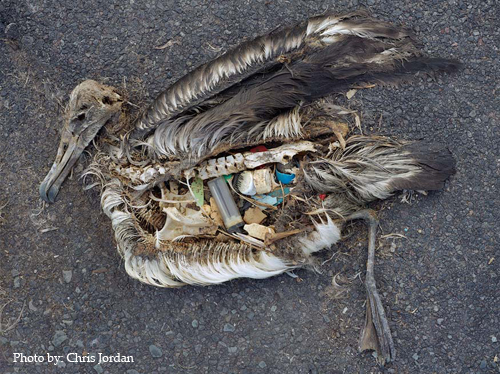
Though we may not be treating our waterways like open sewers as we did a hundred years ago, we are now treating them like landfills. Plastic bags and bottles are more plentiful than fish, and seabirds are dying of malnutrition, because their stomachs are so full of indigestible plastic bits that they can’t fit enough real food in there to sustain their lives. The non-degradable and highly toxic “disposable” plastic waste of our world has been converging in five different gyres in our major oceans and numerous smaller others in our seas.
In 1997, ocean sailing racer Charles J. Moore happened across a floating landfill in the Pacific Ocean, a pile of garbage somewhere between the size of Texas and the entire United States, depending on prevailing weather, currents and how you define the edge. Here converging ocean currents have collected this rubbish at an ever-increasing rate. The plastics are the worst of it, slowly breaking down—but not degrading—into smaller and smaller bits. This plastic particulate matter remains a polymer down to the molecular level, leaching a number of toxins into our water and food supplies along the way. Imagine a watery split pea soup that’s been left in the fridge a few months longer than is advised. This is what the ill-defined areas of these gyres looks and feels and smells like; it isn’t like a floating pile of trash. In fact most of the larger items are below the surface. A large container ship, which traffics these gyres the most, would likely not notice much of a difference from the normal amount of plastic floating in other bodies of water. For this reason, there is still some opposition to the idea that these gyres exist, but there is no denying what results from them.
It is likened unto a watershed, but less pleasant: the smaller bits are eaten by little fish and crustaceans, who are eaten by larger fish, porpoises, turtles and sea birds (who also consume the larger bits of plastic); perhaps by a tuna or sea bass, which then wind up right on our plates. We have, as a species, forgotten what sustains us, forgotten how to care about it. We have to learn this relationship anew, learn how and why to care.
On the Gauley, a few rapids further down, a group of five of us is sitting on a rock in the middle of the river, scouting the next rapid. Where we sit, the river has widened to about 250 feet across, though it’s rather shallow for most of this expanse, with just a narrow 20-foot channel where it deepens from three feet to well over 15. Looking down-river into the channel, a rock shelf enters from the right bank, sloping down along the flow of the river. Just as the series of waves peaks, that shelf dips below the surface and the wave train takes a turn to the left before pillowing off of the boulder just below. This creates what is called a pour-over, where the water—you guessed it—pours rapidly over an obstacle—the jutting shelf of rock, in this case—and jets deep down beneath the surface with gusto. The line here is pretty much straight down the wave train and then, a bit before the shelf, quickly aligning the boat to it and heading down to the left and skirting around the barely submerged section and its nasty pour-over, but staying right of the boulder where the water pillows into its own problematic little gyre.
We hop back into our boats, stretch our skirts over the cockpit rims (this keeps the water out, and keeps us in, especially when upside down) and launch into the river. One by one, paddling fast with a blade always in the water, my friends run the line. I make it to the crest of the 12-foot rolling wave and flip, getting nicely stuck in a weird little space where my roll doesn’t work so much. This is where, as a kayaker, I realize that very shortly my boat and I will scrape across that submerged rock and pour on over. Struggling to roll up, I realize that I don’t want to be between that rock and my hard boat, so I pull the grab loop at the front of my skirt, popping it off the boat and popping myself out. Thing is, that pour-over has much more of a downward pull than the upward pull of my life vest—a potential problem. However, my kayak—upside-down and still full of air—is much more buoyant, so I maintain a death grip on the cockpit rim. My boat drags me over the rock shelf, and into the pour-over, which pulls me and my boat straight down a good 10 feet, and then the 40 gallons of air trapped in my upside-down boat makes a beeline for the surface, pulling me with it.
Deep breath and grin.
About 30 years ago, groups of kayakers started using this awe-and-terror inducing excitement, this sense of pride an accomplishment, this drive to go just a bit further and achieve just a bit more to restore our creeks, rivers and bays. A creek called Clear in Golden Colorado was the first. Clear Creek had been relegated to little more than a drainage ditch running through an un-zoned tract of land and through the middle of downtown. By cleaning up the banks, building some kayak play features and seating and reintegrating the creek into the fabric of the town, instead of hiding it in culverts, the small town of Golden, Colo. leveraged an initial investment of under $200,000 into a $1.9 million dollar economic return in its first year. But more importantly, it became a place that people came to again, and cared for. In all of my visits to the park, I have never once seen a piece of trash lying around, or floating its merry way down the creek. People in the neighborhood go out to enjoy the creek and watch the kayakers—only about 10 percent of those who visit the park actually engage with the water directly.
That foresight is what we as kayakers excel at; we look ahead and recognize the obstacles and the goal and figure out what it takes to get there - often thinking incredibly fast to do so. Banging down our rocky creeks, floating and surfing down our rivers and cutting smoothly through the surf and across the oceans are more than a few brightly-colored plastic solutions to these problems. Kayakers have, via their kayaks, a view of our waterways that few others ever see. Being on—and often in—the water, we know it up-close and personally. We can read its flow and plan our course; we know how it lives and when it is not well. We call attention to threats and we repair damages. We initiate others into our stewardship. To kayak is to do many things - to laugh, to scream, to be filled with adrenalin and dopamine, to be driven by yourself just as you are driven by the power of the water downstream, but most of all it is to have an intimate and possessive understanding and concern for the waterways’ welfare.
Learning anything, including kayaking, is unquestionably easiest at a younger age, though I have taught people well into their seventh decade how to paddle and roll. Of all of these lessons, however, my favorites have definitely been the weeklong summer sessions with teenagers. In one short week, we take these kids from never having been in a kayak to running class-three rapids and rolling like champs. Along the way, they learn care for the river, connecting the seemingly unconnected parts of their life to the health of the rivers they come to love and live on. They learn to look ahead, farther down the river and see the signs, chart their paths amid the dangers and the possibilities and work hard to get where they need to be in order to make it through. Over the course of the week I see the lessons I’m teaching them - the connections I’m helping them to draw – begin to alter the course of their lives. Many of these kids have become people I stay in touch with, bump into at river cleanups and who now recruit me into their own world-bettering endeavors.
Ultimately, it winds down to a few simple concepts. Water is an incredible resource. It is also incredibly important to life—all life, and especially human life. We’ve got some incredible ideas and energy working to repair our relationships with water, and those ideas often repair much more while they are being enacted. At base level, we need to pave less, consume less and keep in mind that the only way to ensure that plastic bottle doesn’t make its way into our oceans, an albatross’ stomach and perhaps even our bloodstream is to simply never buy it, and never drink out of it. Use something reusable. Consume less, experience more.
These thoughts race through my head on a loop as I blink away the whitewater spray, looking for the cool green tongue of water that indicates the route through this angry maelstrom of West Virginia river.
The world drops out from under me to my right, and I quickly snap my right hip up and slam my right paddle blade down, searching for purchase against a surface of water that is no longer there. I go over, and my small green kayak settles back down. But this time, I’m 180 degrees off from where I want to be—hanging straight underneath the boat, mouth clamped tight to keep in my anxious breath. I tuck forward, paddle lined up alongside the boat, and wait for the right moment; that instinctual feeling where the rapid has calmed just enough that there will be purchase on my paddle blade again.
The moment needs to come soon: my lungs are burning, and my helmeted head is bouncing off of far more rocks than I’d like. And then, I feel it. I make a few subtle motions with my hips, knees, arms, and wrists and I’m back upright, mouth open, breathing again. As the water runs off of my face, I rapidly scan my surroundings, and dead ahead is what is shaping up to be a very large wave. Loose hips, paddle in the water, I crest the wave, paddling hard, and fly down the far side of it, whooping joyously. I ride through a few more small waves and quickly drop my paddle across an eddy line and pull into the calm water, waiting for the rest of my group.
We are running down the Gauley River, some of the best whitewater in the United States, and possibly the world. We’re here for a festival celebrating the fact that there is still a river here, accessible to boaters. 30 years ago, there was a large hydroelectric plant and accompanying dam planned for the Gauley river which would have diverted 100 percent of the flow, destroying not only recreational boating, but also miles and miles of natural habitat.
Ultimately, thanks to the efforts of American Whitewater, an incredible cross-section of the country came out to protest the blockage. While a dam and a power plant were built, the entire river flow was never diverted; habitat was saved, and access and dam releases for recreation were assured. This victory was the first of its kind, and set in motion a bevy of further wins all over the country.
In October, and especially Gauleyfest weekend, there are now well over 3000 people each day who raft and boat on about 20 miles of river, which is split up into three sections—upper, lower and middle—in descending order of difficulty. Gauleyfest is the largest river festival in the world, and the oldest, but definitely not the only one.
***
Two hundred years ago, waterways were the lifeblood of the communities that sprang up along their banks. Waterways provided not just water, but milling power, transportation and recreation. One hundred years ago, our waterways took a turn for the worse, becoming our dumping grounds. We would wash our increasingly high volume of waste products down and away from us, but toward the next town down-river, thus choking and poisoning each other, and our environment.
A few rivers actually caught fire. That was enough to catalyze an immediate change in what we put into rivers—but not, ultimately, our attitudes toward them. Ceasing to be the center of our communities, rivers were relegated to dirty, unsafe and ugly places.
We continued to pave over the entire country,
filling in, burying and hiding our neighborhood
creeks and streams, relegating our rivers'
existence from our places of existence.
filling in, burying and hiding our neighborhood
creeks and streams, relegating our rivers'
existence from our places of existence.
Though we aren’t unwittingly using our rivers as landfills quite as much as we used to, we still ultimately treat them like open sewers; quite literally, when those bodies of waters flow past older urban or agricultural areas. The cities of the East Coast of America, for example, have combined sewer systems, which essentially means that storm water is piped into the same sewers as the sewage. When these cities were originally built, it was not a problem. However, as they grew and developed—and, let’s be honest, sprawled—we paved over ever more surface area, thus dramatically increasing the amount of storm water that washed into sewers instead of soaking into the ground and eventually making its way to the aquifers. At some point, the amount of water run off during a normal rainstorm surpassed the total available space for holding and processing sewage. The result of this is termed a “combined sewer overflow event": raw sewage pouring into our streams, rivers, lakes and bays.
Most developed nations in the world now manage water resources along these watershed lines—but some, like New Zealand, have taken it a step further and drawn their municipal district boundaries along them as well. Considering the importance of water to civilization, this makes an incredible amount of sense, especially when you start to consider the wars that have been—and still are being—fought over access to water.
In April, 2000 a small town in the Bolivian Andes, Cochabama, erupted over doubling and tripling water prices—prices charged for their own water by a foreign company granted a 40-year lease by the Bolivian Government at the behest of the World Bank. Five years later, 300,000 people were still without access to safe and affordable drinking water. Today, there is access to filtered water, but the poor pay 10 times as much as the rich and only have perhaps four hours a day during which the water might run. This story can be repeated over and over: different location, same general idea.
Even when water is found, it is polluted and requires money in order to be safe and life sustaining once again. We have polluted our entire world’s water to the point that on its own, it can not sustain us any longer. Most "First World" nations provide these filtering and treatment services as a tax-funded service of government, but that service is increasingly replaced by private bottled water companies—like the one who held the riot-inciting lease in Cochamba.
First world residents are so concerned about the safety of the water that they pay hundreds of times more than the going municipal rate for the exact same water to be put into a plastic bottle, chilled and provided to them in discrete, individual-use packages when and where ever they might decide they would like a sip. As a result, first world residents consume and discard an incredible amount of disposable, non-degradable and rather toxic plastics—among many, many other items—on a daily basis. A lot of these plastic containers end up in our waterways, even the plastic containers we put properly in the trashcans. All of that plastic starts in our communities, and simply putting it in the trash instead of tossing it on the ground is not enough to keep it out of our waterways and oceans.
Though we may not be treating our waterways like open sewers as we did a hundred years ago, we are now treating them like landfills. Plastic bags and bottles are more plentiful than fish, and seabirds are dying of malnutrition, because their stomachs are so full of indigestible plastic bits that they can’t fit enough real food in there to sustain their lives. The non-degradable and highly toxic “disposable” plastic waste of our world has been converging in five different gyres in our major oceans and numerous smaller others in our seas.
We have, as a species, forgotten what sustains us, forgotten how to care about it. We have to learn
this relationship anew, learn how and why to care.
this relationship anew, learn how and why to care.
In 1997, ocean sailing racer Charles J. Moore happened across a floating landfill in the Pacific Ocean, a pile of garbage somewhere between the size of Texas and the entire United States, depending on prevailing weather, currents and how you define the edge. Here converging ocean currents have collected this rubbish at an ever-increasing rate. The plastics are the worst of it, slowly breaking down—but not degrading—into smaller and smaller bits. This plastic particulate matter remains a polymer down to the molecular level, leaching a number of toxins into our water and food supplies along the way. Imagine a watery split pea soup that’s been left in the fridge a few months longer than is advised. This is what the ill-defined areas of these gyres looks and feels and smells like; it isn’t like a floating pile of trash. In fact most of the larger items are below the surface. A large container ship, which traffics these gyres the most, would likely not notice much of a difference from the normal amount of plastic floating in other bodies of water. For this reason, there is still some opposition to the idea that these gyres exist, but there is no denying what results from them.
***
On the Gauley, a few rapids further down, a group of five of us is sitting on a rock in the middle of the river, scouting the next rapid. Where we sit, the river has widened to about 250 feet across, though it’s rather shallow for most of this expanse, with just a narrow 20-foot channel where it deepens from three feet to well over 15. Looking down-river into the channel, a rock shelf enters from the right bank, sloping down along the flow of the river. Just as the series of waves peaks, that shelf dips below the surface and the wave train takes a turn to the left before pillowing off of the boulder just below. This creates what is called a pour-over, where the water—you guessed it—pours rapidly over an obstacle—the jutting shelf of rock, in this case—and jets deep down beneath the surface with gusto. The line here is pretty much straight down the wave train and then, a bit before the shelf, quickly aligning the boat to it and heading down to the left and skirting around the barely submerged section and its nasty pour-over, but staying right of the boulder where the water pillows into its own problematic little gyre.
We hop back into our boats, stretch our skirts over the cockpit rims (this keeps the water out, and keeps us in, especially when upside down) and launch into the river. One by one, paddling fast with a blade always in the water, my friends run the line. I make it to the crest of the 12-foot rolling wave and flip, getting nicely stuck in a weird little space where my roll doesn’t work so much. This is where, as a kayaker, I realize that very shortly my boat and I will scrape across that submerged rock and pour on over. Struggling to roll up, I realize that I don’t want to be between that rock and my hard boat, so I pull the grab loop at the front of my skirt, popping it off the boat and popping myself out. Thing is, that pour-over has much more of a downward pull than the upward pull of my life vest—a potential problem. However, my kayak—upside-down and still full of air—is much more buoyant, so I maintain a death grip on the cockpit rim. My boat drags me over the rock shelf, and into the pour-over, which pulls me and my boat straight down a good 10 feet, and then the 40 gallons of air trapped in my upside-down boat makes a beeline for the surface, pulling me with it.
Deep breath and grin.
That foresight is what we as kayakers excel at; we look ahead and recognize the obstacles and the goal and figure out what it takes to get there - often thinking incredibly fast to do so. Banging down our rocky creeks, floating and surfing down our rivers and cutting smoothly through the surf and across the oceans are more than a few brightly-colored plastic solutions to these problems. Kayakers have, via their kayaks, a view of our waterways that few others ever see. Being on—and often in—the water, we know it up-close and personally. We can read its flow and plan our course; we know how it lives and when it is not well. We call attention to threats and we repair damages. We initiate others into our stewardship. To kayak is to do many things - to laugh, to scream, to be filled with adrenalin and dopamine, to be driven by yourself just as you are driven by the power of the water downstream, but most of all it is to have an intimate and possessive understanding and concern for the waterways’ welfare.
Kayakers have, via their kayaks, a view of
our waterways that few others ever see.
Being on--and often in--the water, we know it up-close and personally. We can read its flow and plan our course; we know how it lives and
when it is not well.
our waterways that few others ever see.
Being on--and often in--the water, we know it up-close and personally. We can read its flow and plan our course; we know how it lives and
when it is not well.
Learning anything, including kayaking, is unquestionably easiest at a younger age, though I have taught people well into their seventh decade how to paddle and roll. Of all of these lessons, however, my favorites have definitely been the weeklong summer sessions with teenagers. In one short week, we take these kids from never having been in a kayak to running class-three rapids and rolling like champs. Along the way, they learn care for the river, connecting the seemingly unconnected parts of their life to the health of the rivers they come to love and live on. They learn to look ahead, farther down the river and see the signs, chart their paths amid the dangers and the possibilities and work hard to get where they need to be in order to make it through. Over the course of the week I see the lessons I’m teaching them - the connections I’m helping them to draw – begin to alter the course of their lives. Many of these kids have become people I stay in touch with, bump into at river cleanups and who now recruit me into their own world-bettering endeavors.
Ultimately, it winds down to a few simple concepts. Water is an incredible resource. It is also incredibly important to life—all life, and especially human life. We’ve got some incredible ideas and energy working to repair our relationships with water, and those ideas often repair much more while they are being enacted. At base level, we need to pave less, consume less and keep in mind that the only way to ensure that plastic bottle doesn’t make its way into our oceans, an albatross’ stomach and perhaps even our bloodstream is to simply never buy it, and never drink out of it. Use something reusable. Consume less, experience more.