
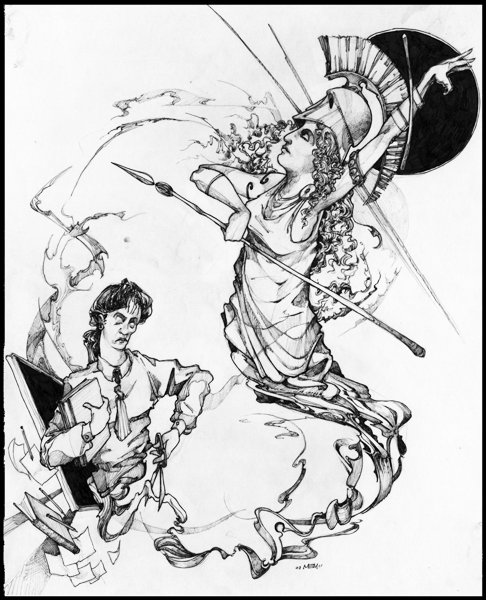
Illustration by Matt McCann
Continued from "I Resign: Part I."
The extreme action of my resignation from teaching begs the question: Why?
But before addressing that, let me please express what I already know. I know that my leaving will be emotionally traumatic for my students, as it certainly will be for me. I also know that I will leave, in my absence, a wake of confusion as to why I would possibly abandon both the students, and the larger community of our school mid-year. I am aware that people will opine, and that some of their opinions will look at my decision in a less-than-favorable light, chalking it up to my lack of dedication, or perhaps my just not having the true grit to be an urban educator.
Some will say that my students will suffer academically because of this decision to leave, and that the guilt of putting 90 students academically at risk must sit squarely on my shoulders. Many of these musings may ultimately be true. And, should my students suffer academically as a result of my actions, I can do nothing but take on that responsibility.
However, the reality of education is that upon my departure, my students will have another teacher. They will learn. Whether they will learn less or more is dependent on a variety of factors, but as human adolescents, learning is what they are programmed to do. So, these bases covered, one larger question remains: If I know all of these negative consequences of leaving, if leaving mid-year may be the most frowned-upon action in the teaching profession, if leaving my students may very well break my heart—why do I still insist on resigning?
At some point, teaching—the act of being a teacher—must become meaningful. Not just to the individual teacher, but to the school and the system. Over the past months, I found myself systematically disempowered as an educator, to the point where I was no longer able to hold onto the very reasons I was teaching: equity, respect, vision.
Instead, I was overworked, under-supported and treated with a level of condescension and subtle disrespect that I firmly believe is saved for teachers. Because of these factors, I reached a point where my kids no longer brought me joy. In turn, I could not reach them as necessary. Do not misunderstand that I say this to mean that the kids are somehow responsible for my decision. I cannot stress ardently enough that this is not the case. My passion was not deadened because of my students, but because of everything that took me away from them.
***
The reality of my life as a teacher rapidly devolved into something unmanageable. I lacked effective administrative support. Some of my coworkers had not been educated as teachers. They were misinformed about the process of learning. This flaw expressed itself in everything from an immense disorganization regarding the day-to-day operations of the building, to a highly flawed philosophy of education that often valued appearance of learning—or, at the very least, orderliness—over the act of learning. While I state that this was my specific context, this is not a unique experience for an urban educator.
I found myself faced with a decision. I could exist thirteen hours a day in the building, tutoring students who were drastically below grade level in the mornings (sans monetary compensation). I could then spend the official school day juggling basic fundamental, and unacceptable inefficiencies: no substitute coverage when teachers were absent, ineffective notification of parents for early dismissals, lack of student rosters, class sizes ranging from 13 to 50 because of poor scheduling decisions. And I could spend my evenings attempting to plan for the work I was actually hired to do, which is to teach the children, and focus on their needs. But choosing to live this life was actively reinforcing a stereotype that is detrimental to the profession of teaching: The stereotype of urban teacher as martyr—martyr, as opposed to well-educated, knowledgeable and skilled professional.
Try to think of all the popular cinematic depictions of urban teachers: Robin Williams in the Dead Poets Society, Edward James Olmos in Stand and Deliver, Michelle Pfeiffer in Dangerous Minds. These films all depict the common trope of the teacher-hero, a lone individual in a broken system of uninspiring instruction and burnt-out teachers. The message of these movies is that an individual artist of oration—the unbelievably empathic individual who can connect with even the most distant of students—is the only one who can create effective learning and inspiration.
This stereotype sets up a false dichotomy. Good teachers work alone, inventively and exhaustively. Poor teachers are everyone else.
In reality, expectations for instructor professionalism, preparedness and education are low. Inspired instructors burn out without a highly educated, thoughtful, openly discursive and student-centered staff and administration who support the work we attempt in the classroom. We do not need to accept this, and our teachers absolutely cannot accept working like martyrs.
There are many things one expects as an educator; parts of the game that are not only inevitable, but are so often referenced as cliché. The system is underfunded and rife with bureaucracy. The students are coming into the classroom with extensive needs—not only academically, but also socially and emotionally. There is violence, systemic and widespread. Anger infuses even the most basic interactions. Poverty is ubiquitous. Ninety-degree classrooms sit with too few desks, and too many students. Parents—perhaps because of their own experiences as students, or just because of the disregard they have encountered towards their own children—are completely disenchanted with the educational process.
If you have really been prepared to be an urban educator, you anticipate these realities, which are often outside of a school’s direct control. For example, it is the district that manages building maintenance. But a school culture where mediocrity is not addressed, or often, even celebrated? These realities are wholly within the control of individual schools and communities.
At my school, I saw teachers leave, and as they left, individuals with no educational experience, no teaching certification (charter schools are permitted to hire uncertified teachers), no formal training at all, were hired to replace them. Why? Because these individuals had “good energy” or an “interesting background.” Though their hearts are surely in the right place, without the tools to be an effective educator, how could they possibly teach our children? The answer lies back in the idea of the teacher hero: That being an educator is not learned. Effective teaching is not a skilled profession like being a doctor or lawyer, but rather an “energy” or an “art” that anybody who has ever been a student could possess. This belief is not only a lie, but it completely isolates educators from one another.
If teaching is akin to personal magic, then all learning is based on a cult of personality, leaving no room for collegial dialogue around strategy, best practice, and how to create a classroom that truly responds to the students needs. The environment becomes about the individual adults, and ceases to be about our children who need us so badly.
***
I recently got into an argument with a vice-president of an international union regarding the merits of teachers, and alternative certification programs such as Teach For America (TFA). I argued, and will continue to argue, that these programs hurt the profession of teaching because they lower the standard for what it means to be a professional educator. Essentially, what TFA and other programs similar to it insist is that any relatively intelligent person can enter a high-needs classroom with little-to-no preparation and be a successful teacher.
(As an aside, after a number of years—it is generally said five—these alternatively-certified teachers can become excellent educators. But most of them do not last that long).
I asked the woman I was arguing with if she would hold the same standard for her doctor. Would it be OK with her if her doctor was educated ad hoc, with no formal training in advance, and if she, not being able to afford any better, was the guinea pig?
She asserted it was not an apt comparison. I am saddened by this apparently endemic belief of panache-as-skill that exists not just in the minds of lay people, but in those of administrators, teachers and often parents alike. Teachers are literally building the capacity of our future as a country, and yet we see the profession as devoid of tangible skill? I cannot express how incorrect this is. I am a highly-educated woman. I am bilingual. I have lived and studied in multiple foreign countries. I have two degrees from the University of Chicago, and I can say unequivocally that teaching, by far, is the most intellectually challenging work I have ever done.
So I am leaving education, temporarily, as an act of self-respect. As teachers, highly qualified and skilled teachers, how can we ever expect to work in an environment that supports us, supports our students, and respects the work we do if we do not respect ourselves in our own professional capacity? If I continued to be the “hero” teacher (a role which I do not willingly take on), I would continue to work alone, treading water in an unresponsive system, serving my students for a year, only to watch them drown as they are processed through high school and onto graduation with mediocre skills, and little of the original equity I had wanted for them.
I am not leaving education forever, but hopefully, in this brief reprieve, I can figure out some way to help tackle the massive issue of what it means to actually be an educator.